

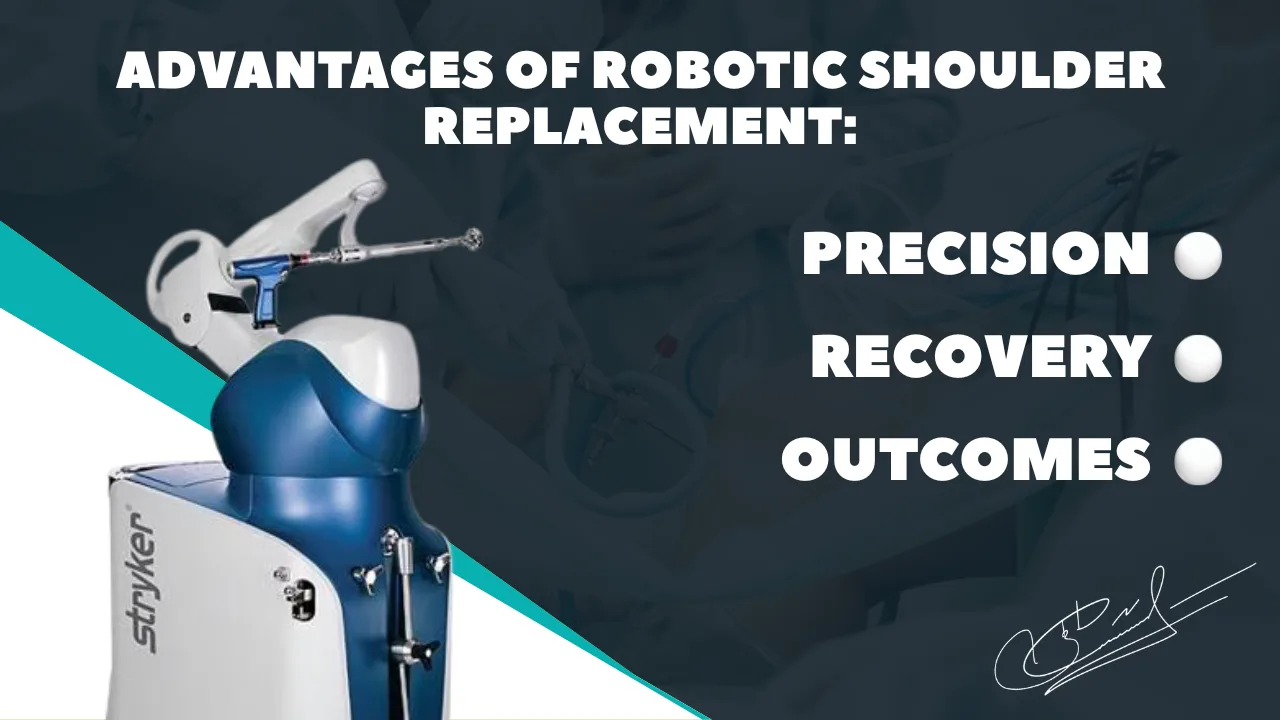
Advantages of robotic shoulder replacement: precision, recovery, and outcomes
When discussing robotic shoulder arthroplasty, the conversation almost always starts with the word “precision.” This is logical, but in real clinical practice, the situation is more complex. For both the surgeon and the patient, it is not only about how accurately the implant is positioned, but how the joint will function after surgery — in a month, a year, or several years.
From this perspective, it makes sense to evaluate the use of the MAKO SmartRobotics™ system.
(For a step-by-step explanation, see “How the MAKO robot works in shoulder joint replacement.”)
Why precision is especially critical in the shoulder joint
The shoulder is inherently less stable compared to other joints. Its wide range of motion comes at the cost of reduced bony stability. Therefore, even small deviations in glenoid component positioning can have a greater clinical impact than in joints such as the knee.
In practice, this may look like a technically “well-performed” operation, yet the patient still experiences pain, instability, or limited movement. In many such cases, the underlying issue is component orientation.
Robotic assistance does not eliminate all challenges, but it allows more precise control over factors that directly depend on the surgeon.
What robotic assistance provides in practice
It is sometimes said that an experienced surgeon does not need a robot. This is partly true.
However, the real question is not whether a surgeon can perform a good operation, but how consistently that result can be reproduced in complex cases.
MAKO helps to:
• maintain planned alignment and positioning angles;
• avoid excessive bone resection;
• improve control in cases of glenoid deformity.
In practice, especially in complex anatomy, the sense of “control over the process” becomes crucial. The robot does not replace the surgeon — it supports them.
Impact on recovery: realistic expectations
Patients often assume that robotic surgery automatically leads to faster and easier recovery. This is not entirely accurate. Rehabilitation after shoulder arthroplasty depends on muscle condition, tendon integrity, the extent of surgery, and adherence to postoperative recommendations.
However, there is an important point:
When implant components are positioned as accurately as possible and joint biomechanics closely match natural anatomy, recovery tends to be more predictable. Unexplained pain is less frequent, load progression is easier to manage, and rehabilitation planning becomes more structured.
This is not the effect of “technology magic,” but the result of proper biomechanics.
Outcomes and implant longevity
In the long term, implant positioning is one of the key factors determining prosthesis durability. Incorrect orientation of the glenoid component can increase stress on fixation zones and lead to earlier wear or loosening.
Robotic assistance helps to:
• preserve more bone stock;
• reduce the risk of technical errors;
• potentially improve implant longevity.
Long-term data specific to MAKO Shoulder is still limited, but experience with robotic hip and knee arthroplasty suggests that this approach is justified.
When robotic assistance is most beneficial
It is important to understand that robotic technology is not necessary in every case.
In straightforward clinical situations, conventional techniques remain effective and reliable.
The greatest benefit of MAKO is seen in cases of:
• significant glenoid deformity;
• post-traumatic changes;
• revision surgery;
• complex or non-standard anatomy.
(For clinical examples, see “First MAKO Shoulder procedures: experience from Australia and the USA.”)
Robotic shoulder arthroplasty is not about replacing the surgeon or following trends. It is about control, reproducibility, and reducing technical risks in situations where precision is critical.
MAKO SmartRobotics™ does not guarantee a perfect outcome, but it helps make good results more consistent — which is especially important in shoulder surgery.
