

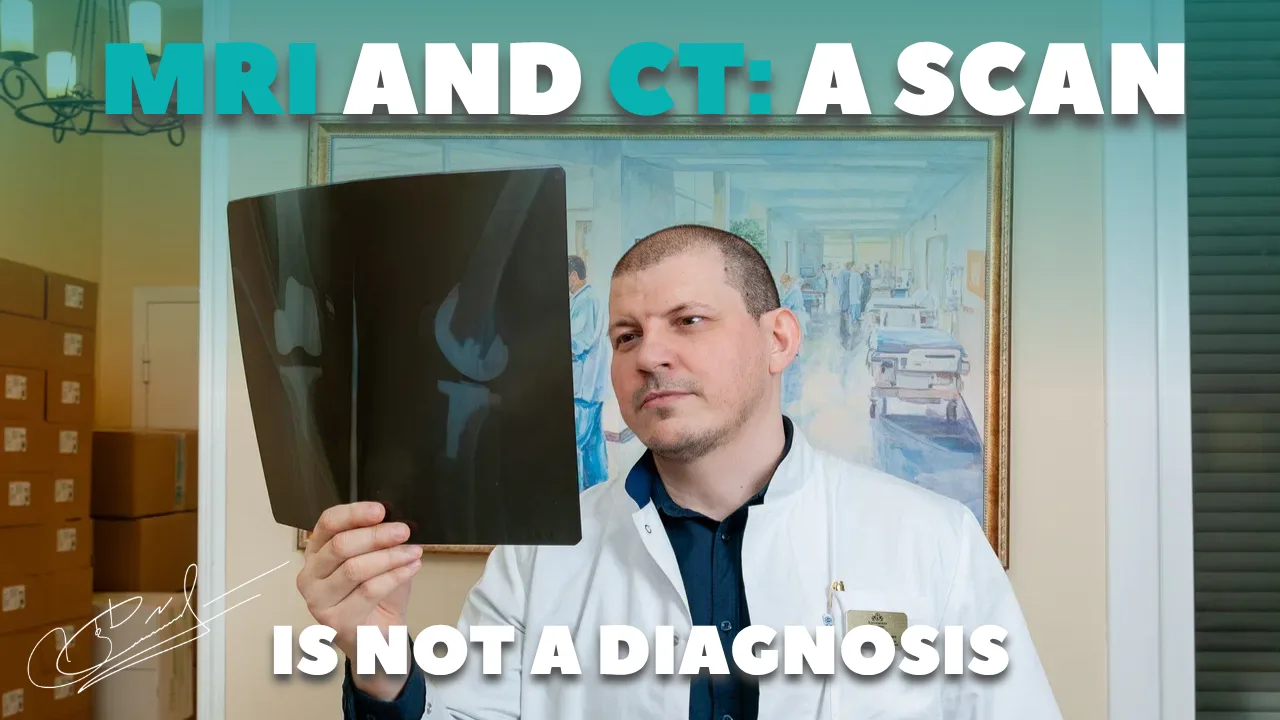
Errors in interpreting MRI and CT scans of joints: why imaging is not a diagnosis
Modern imaging methods allow detailed evaluation of bone structures and soft tissues. However, even high-precision imaging is not a definitive clinical decision.
An MRI or CT report describes findings — it is not an automatic indication for surgery.
Why imaging findings do not always match symptoms
It is not uncommon to encounter situations such as:
• pronounced degenerative changes with only moderate pain;
• significant pain despite relatively “mild” imaging findings;
• discrepancies between the report and clinical examination.
Imaging reflects morphology, but not always the functional state of the joint.
Common interpretation errors
Typical issues include:
• evaluating scans without correlating with symptoms;
• lack of assessment of disease progression over time;
• inaccurate measurement of angles and anatomical parameters;
• overdiagnosis of partial lesions.
This is particularly important when planning hip arthroplasty.
(If surgery has already been recommended based on imaging, see “You’ve been advised to undergo surgery: how to know if it’s really necessary?”)
Importance of proper analysis when choosing the approach
In joint replacement, accurate anatomical assessment determines:
• orientation of the acetabulum;
• morphology of the proximal femur;
• degree of deformity;
• need for additional procedures.
When planning a minimally invasive anterolateral intermuscular Röttinger approach, spatial evaluation of bony landmarks is especially important.
When imaging should be reassessed
Re-evaluation is justified if:
• opinions of different specialists differ;
• revision surgery is being considered;
• pain persists without a clear cause;
• there are doubts about measurement accuracy.
(For differing opinions, see “Different doctors, different opinions: who should you trust?”)
The role of technology
Modern navigation and robotic systems rely on CT data for preoperative planning. Therefore, the accuracy of initial interpretation directly affects the final outcome.
(For more details, see “Can the Röttinger approach be combined with robotic navigation?”)
MRI and CT are essential tools, but they must be interpreted within the clinical context.
Accurate interpretation reduces the risk of unnecessary decisions and improves predictability of treatment.
A comprehensive assessment helps choose the optimal strategy, rather than relying solely on the wording of a report.
