

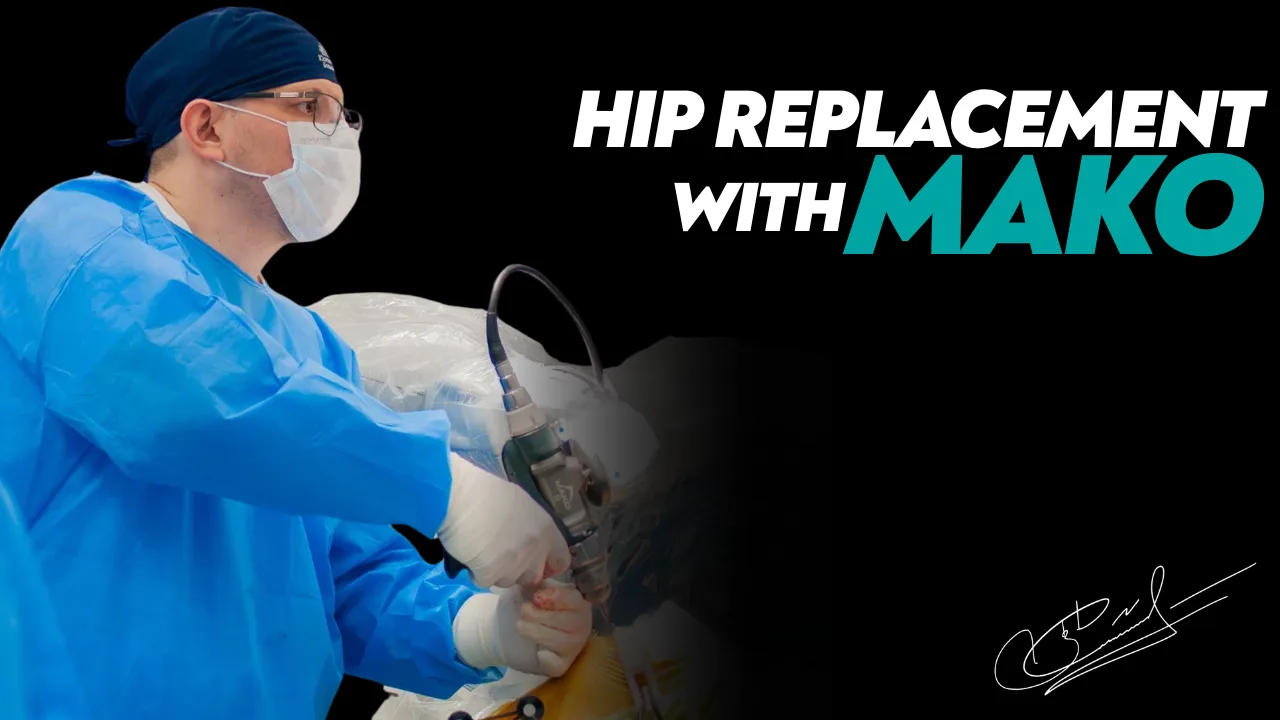
Hip Replacement with the Mako Robot: Surgical Features
When Hip Replacement is Required
The hip joint is subjected to significant daily loads. Over time, its structures can wear down, leading to pain, limited mobility, and reduced quality of life.
One of the most common reasons for surgery is advanced hip osteoarthritis. In this condition, the joint cartilage gradually deteriorates, and movement becomes painful.
More information about the causes of the condition can be found in the article “Hip Osteoarthritis: How the Disease Develops and Treatment Options.”
When conservative treatment methods are no longer effective, joint replacement surgery may be considered. More details on when surgical treatment is recommended can be found in the article “When Is Joint Replacement Indicated?”
You can also learn more about the procedure on the hip replacement page.
What the Mako Robot Is in Hip Surgery
The Mako robot is a robotic navigation system used for planning and controlling surgical parameters. It helps the surgeon more precisely determine implant positioning and account for the patient’s individual anatomy.
More details about the technology, how it works, and its capabilities can be found on the Mako robot page.
The use of such technology allows surgical parameters to be calculated in advance and controlled during the procedure.
Preoperative Preparation
Before surgery, the patient undergoes a thorough evaluation. Computed tomography (CT) plays a key role, as it is used to create a digital model of the hip joint.
This model is used for preoperative planning. The surgeon can determine in advance:
- implant component size
- implant positioning
- structural features bone anatomy
More details about digital planning can be found in the article “Mako Robot and 3D Surgical Planning: How a Digital Joint Model Is Created.”
Main Stages of the Procedure
Hip replacement surgery using a robotic system follows standard surgical principles but includes elements of digital navigation.
During the procedure, the surgeon:
- gains access to the joint
- prepares bone surfaces
- implants prosthetic components
- checks joint stability
In some cases, minimally invasive approaches may be used. For example, the anterior approach to the hip joint or the anterolateral intermuscular Röttinger approach.
How the Mako Robot Assists During Surgery
During the procedure, the Mako system functions as a navigation tool. It helps the surgeon follow preplanned parameters and control instrument movements.
This allows:
- more precise bone preparation
- adherence to planned component alignment angles
- control of implant positioning
More details on why implant positioning accuracy is important can be found in the article “Why Implant Positioning Accuracy Depends on Planning: The Role of the Mako Robot.”
Benefits of Robotic Technology
The use of a robotic system helps the surgeon perform surgical steps more precisely and account for the patient’s individual anatomy.
Potential benefits include:
- precise surgical planning
- control of implant component positioning
- consideration of patient-specific anatomy
However, it is important to understand that the surgeon remains the key decision-maker during the procedure.
Can the Robot Perform Surgery Independently?
Some patients believe that the robot performs the surgery on its own. In reality, this is not the case.
The robotic system serves as a navigation and control tool. All surgical actions are performed by the surgeon, who makes decisions at every stage of the procedure.
If surgery has already been recommended, it may also be helpful to read the article “You Have Been Recommended Surgery: How to Know If It Is Truly Necessary.”
Postoperative Recovery
Recovery after hip replacement depends on the patient’s preoperative condition, surgical specifics, and the rehabilitation program.
In the first weeks after surgery, it is important to gradually restore joint mobility and strengthen muscles. The rehabilitation program is tailored individually and helps the patient safely return to normal activity.
When Robotic Technology Is Especially Useful
Robotic systems may be particularly beneficial in cases where high precision in implant positioning is required.
For example:
- significant joint deformities
- complex bone anatomy
- advanced joint surface wear
In such situations, digital planning and navigation help the surgeon perform the procedure more accurately.
The Mako robotic system is a modern tool that helps surgeons plan and perform hip replacement surgery with high precision. The use of a digital joint model and navigation technologies allows for consideration of patient-specific anatomy and control of surgical parameters.
At the same time, the surgeon remains the central figure during the procedure, while robotic technology enhances accuracy and predictability of treatment outcomes.
