

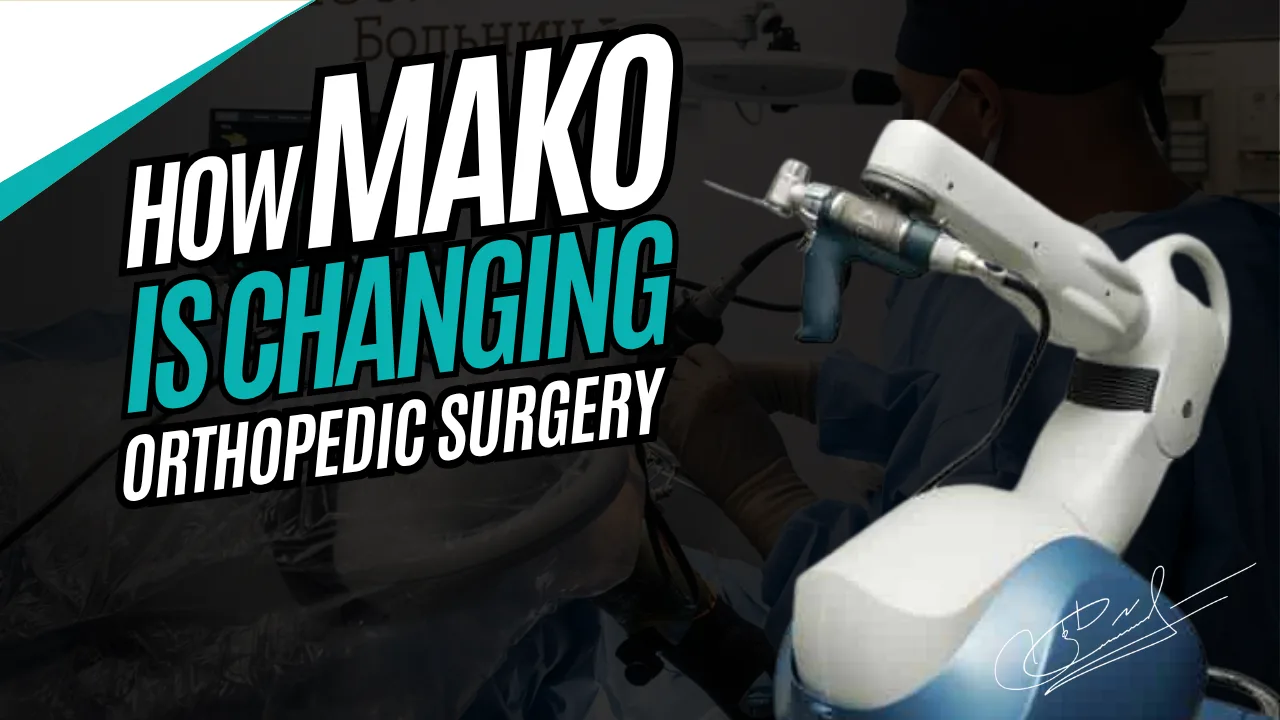
If we look at the development of robotic surgery not from a marketing perspective but through the eyes of a practicing orthopedic surgeon, it becomes clear: MAKO is not about “robots,” it is about control. And this control is not abstract—it is very concrete, over the stages of surgery where mistakes later cost both the surgeon and the patient.
This is why the path of MAKO from the knee to the shoulder appears logical, even though it may seem abrupt from the outside.
Why It All Started with the Knee
The knee joint was the first not because it is “simpler,” but because it is easier to see the difference between the plan and reality. Limb alignment, ligament balance, the extent of resection—these are all measurable and controllable.
For the surgeon, it was a convenient testing ground: it was immediately clear where the robot actually helps and where it is not needed. It quickly became obvious that the main value of MAKO is not in the bone cutting itself, but in the fact that the procedure stops being “by eye.”
Hip Joint: The Next Logical Step
When MAKO appeared in hip arthroplasty, expectations were higher. Here, the cost of an error is even greater: incorrect component positioning quickly leads to clinical issues, and correcting it later is more difficult.
In practice, robotic assistance showed one important fact: even an experienced surgeon does not always reproduce the plan as precisely as they think. This is not a criticism—it is simply human variability. The robot, in this sense, is not “smarter”; it is just consistent.
It was at this stage that it became clear that MAKO is not a one-off technology for a specific joint, but a platform.
Why the Shoulder Stayed “On the Sidelines” for a Long Time
The shoulder joint is a completely different story. It is anatomically more complex, less biomechanically stable, and much more sensitive to component positioning, especially the glenoid.
For a long time, it was believed that robotic shoulder surgery was either unnecessary or too complex for practical use. Some surgeons were skeptical—and there was good reason for caution.
However, the development of CT-based planning and haptic feedback gradually removed these limitations.
(The technical aspects are covered in detail in the article “How the MAKO Robot Works in Shoulder Replacement: Step by Step.”)
What Changed with MAKO Shoulder
The key difference with the shoulder is variability. Two patients with the same diagnosis can have completely different glenoid orientations. This is precisely where the robotic approach becomes important.
MAKO Shoulder does not perform the surgery for the surgeon. It allows the surgeon to understand in advance exactly what will be corrected and ensures adherence to that plan during the procedure.
For the surgeon, this means less improvisation where it is unnecessary and more control where previously they had to rely on experience and intuition.
Why the Path “Knee → Hip → Shoulder” Matters
From a clinical standpoint, the significance is not just that MAKO reached the shoulder, but how it reached it. This was not a “from scratch” experiment; it was the application of already proven logic to a more complex joint.
This is why the first MAKO Shoulder operations were performed not in experimental labs, but in real clinics in Australia and the USA.
(The first clinical series are discussed in the article “First MAKO Shoulder Surgeries: Experience in Australia and the USA.”)
What This Means for Orthopedics in General
The evolution of MAKO demonstrates the broader trend in modern orthopedics: moving from universal solutions to personalized surgery. The robot is not the goal; it is a tool.
The surgeon’s role is not diminished. On the contrary, the importance of planning, understanding biomechanics, and decision-making increases. The technology simply makes these decisions more precise and reproducible.
(The practical advantages of this approach are detailed in the article “Advantages of Robotic Shoulder Arthroplasty: Accuracy, Recovery, Prognosis.”)
Looking at MAKO objectively, it becomes clear: its evolution from the knee to the shoulder is not a race for novelty, but a **systematic effort to reduce errors** where the cost of mistakes is particularly high.
This **calm, step-by-step, clinically grounded approach** defines the future of robot-assisted orthopedic surgery.
