

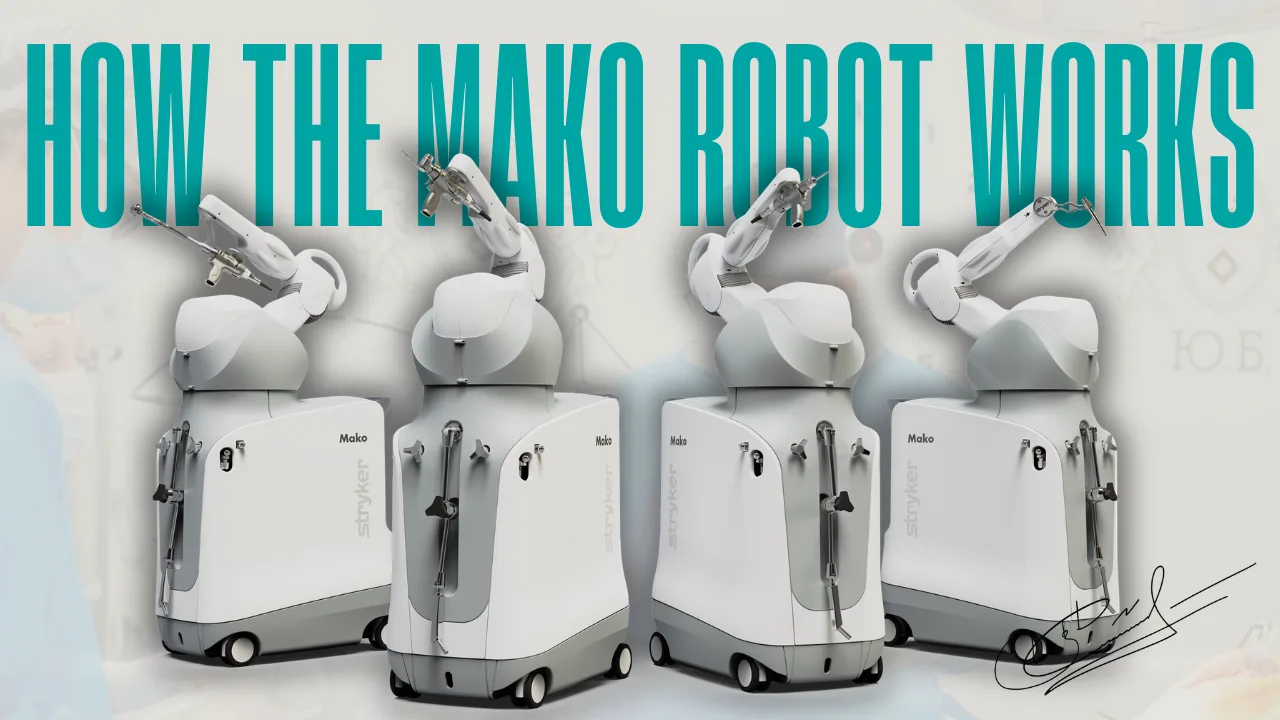
How the MAKO robot works in joint replacement
What is the MAKO robot
The MAKO robot is a modern robotic-assisted navigation system used in joint replacement surgery. Unlike traditional methods, where the surgeon relies primarily on anatomical landmarks and personal experience, MAKO technology allows the creation of a digital model of the patient’s joint and surgical planning before the procedure begins.
The system integrates CT data, specialized software, and a robotic instrument. This enables the surgeon to control key parameters of the operation and work with greater precision.
(For more details, see the MAKO robot page.)
The evolution of robotic joint surgery
Joint replacement is one of the most effective treatments for advanced osteoarthritis and other joint conditions. However, even with high surgical standards, accurate implant positioning and restoration of proper joint biomechanics remain critical.
This is why navigation and robotic-assisted technologies have become increasingly important in modern orthopedics. They allow surgeons to account for individual anatomy and plan procedures in advance.
Today, robotic systems are most commonly used in hip and knee replacement surgeries.
(For more details, see “How robotic surgery differs from traditional surgery.”)
Key stages of MAKO-assisted surgery
Despite its name, the robot does not perform the surgery independently. The surgeon remains the central figure, while the robotic system serves as a tool to enhance precision and control.
The procedure typically includes several stages:
• analysis of CT scan data;
• creation of a 3D digital model of the joint;
• planning of implant positioning;
• execution of the procedure using robotic guidance.
This approach allows precise preoperative planning tailored to the patient’s anatomy.
Why a digital joint model is important
A core element of MAKO technology is the creation of a patient-specific digital joint model based on CT data.
This model helps to:
• assess the shape and orientation of bone structures;
• determine optimal implant positioning;
• simulate joint movement after surgery.
As a result, the surgeon can define the most accurate implant placement before the operation begins.
(For more details, see “3D surgical planning using the MAKO robot.”)
How the robot assists during surgery
During the procedure, the MAKO system helps control the movement of surgical instruments by creating “virtual boundaries” within which the surgeon operates safely.
This allows the surgeon to:
• control the amount of bone resection;
• prepare bone surfaces more precisely;
• ensure accurate implant positioning.
At all times, the surgeon controls the instrument and makes all clinical decisions.
When MAKO is used
In modern orthopedics, MAKO is most commonly used in major joint replacement procedures, including:
• hip replacement;
• knee replacement.
Depending on the clinical situation, different types of procedures may be performed, including total or partial joint replacement.
Can the robot replace the surgeon?
Some patients assume that the robot performs the surgery independently. In reality, this is not the case.
The robotic system is a tool that enhances precision. All key steps are performed by the surgeon, while the technology supports planning, navigation, and control.
Therefore, surgical outcomes still depend on the surgeon’s experience, proper planning, and correct choice of treatment.
When robotic technology is particularly beneficial
Robotic assistance is especially useful in cases requiring high precision in implant positioning, such as:
• complex joint anatomy;
• significant deformities;
• the need for precise restoration of limb alignment.
In such situations, navigation technologies help reduce the risk of positioning errors.
Recovery after robotic surgery
Recovery depends primarily on the type of procedure, the preoperative condition of the joint, and the rehabilitation program.
Robotic assistance does not change the fundamental principles of rehabilitation. However, accurate implant positioning may contribute to more stable joint function and a more predictable outcome.
After surgery, patients undergo a structured rehabilitation process aimed at restoring mobility, muscle strength, and daily activity.
The MAKO robot is a technology that helps surgeons plan and perform joint replacement procedures with greater precision. The use of a digital joint model and robotic navigation allows individualized planning and control of key surgical parameters.
At the same time, the robot does not replace the surgeon — it serves as a high-precision tool that enhances accuracy and predictability.
In modern orthopedics, such technologies are becoming an increasingly important part of hip and knee replacement surgery.
