

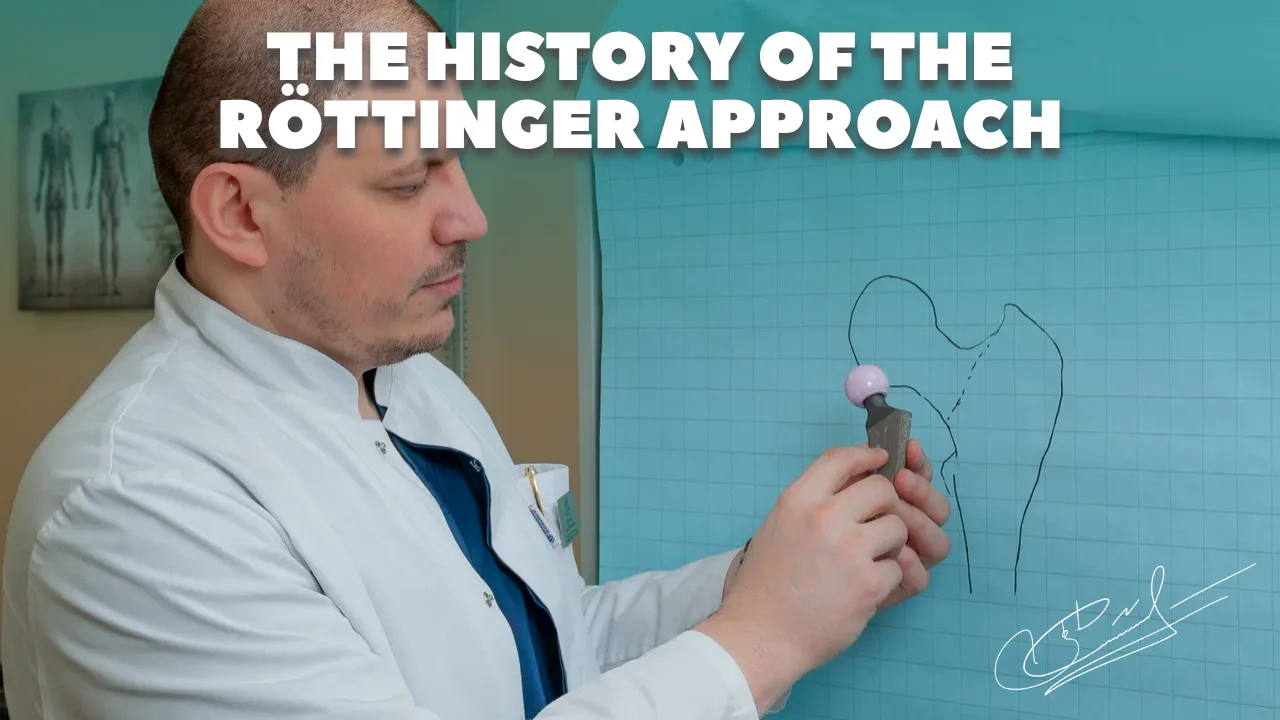
How the Röttinger approach evolved: the development of anterolateral techniques
Modern minimally invasive techniques in hip arthroplasty did not emerge suddenly. They are the result of a gradual evolution of surgical approaches, reassessment of anatomical landmarks, and the ongoing effort to reduce soft tissue trauma.
The Röttinger approach is not a marketing term, but a logical development of the anterolateral surgical school.
From Watson–Jones to the intermuscular philosophy
One of the early anterolateral approaches was the Watson–Jones approach. It utilized an anatomical interval; however, in various modifications, it often involved partial disruption of muscular structures.
Later, techniques emerged that included partial detachment of the gluteus medius to improve joint visualization. This facilitated exposure but increased trauma to the abductor mechanism.
In the early 2000s, the focus shifted toward the concept of tissue-sparing — preserving soft tissues. Surgeons began seeking ways to achieve adequate visualization without disrupting muscular anatomy.
This led to the development of the Röttinger modification — a strictly intermuscular anterolateral approach.
Core principle of the modification
The key principle is operating through an anatomical interval without detaching the gluteus medius muscle.
This allows:
• preservation of the abductor mechanism;
• reduced risk of postoperative limping;
• decreased pain levels;
• improved pelvic stability in the early postoperative period.
(Biomechanical aspects are discussed in detail in “Why the intermuscular approach reduces the risk of limping after surgery.”)
It is important to understand: minimizing the incision is not the goal in itself. The primary focus is preservation of function.
Modern application
Today, the Röttinger approach is used as a standalone technique and can be combined with navigation or robotic systems.
Its anatomical logic provides a convenient surgical field and stable spatial orientation.
(For more details, see “Can the Röttinger approach be combined with robotic navigation?”)
Clinical relevance for the patient
The history of this method shows that the Röttinger approach is the result of surgical evolution aimed at reducing trauma and improving functional recovery.
At our center, we use the minimally invasive anterolateral intermuscular Röttinger approach as an anatomically grounded technique within the anterolateral framework.
The Röttinger approach represents a stage in the evolution of anterolateral techniques, reflecting the modern philosophy of soft tissue preservation and restoration of joint biomechanics.
