

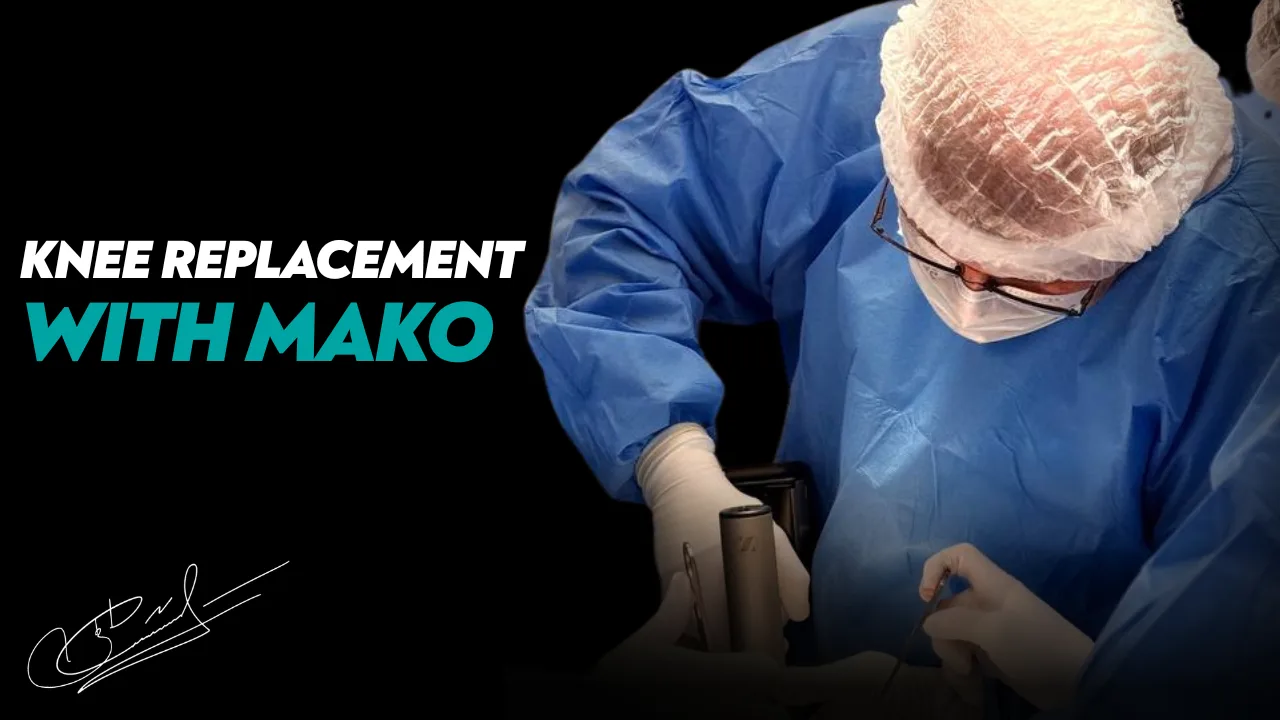
Knee Replacement Using the Mako Robot
When Knee Replacement is Required
The knee joint is subjected to significant daily load during walking, climbing stairs, and other movements. Over time, its structures can wear down, leading to pain, stiffness, and reduced mobility.
One of the most common reasons for surgery is knee osteoarthritis. In this condition, the joint cartilage gradually thins and loses its shock-absorbing properties, making movement painful.
More information about disease progression can be found in the article “Knee Osteoarthritis: How the Disease Develops and When Surgery May Be Needed.”
If the disease progresses to an advanced stage and conservative treatment no longer provides relief, joint replacement surgery may be considered.
More details about this treatment method can be found on the knee replacement page.
What the Mako Robot Is in Knee Surgery
The Mako robot is a robotic navigation system used for planning and controlling surgical parameters. It helps the surgeon more precisely determine implant positioning and account for the individual anatomical features of the knee joint.
The technology uses computed tomography (CT) data to create a digital model of the patient’s joint.
More details about how the system works can be found on the Mako robot page.
How the Procedure is Planned
Before surgery, a three-dimensional model of the patient’s knee joint is created. This allows the surgeon to study anatomical features in advance and calculate the parameters of the upcoming procedure.
During planning, the following are analyzed:
- bone structure positioning
- limb alignment
- expected implant component positioning
More details about digital planning can be found in the article “3D Surgical Planning Using the Mako Robot.”
Types of Knee Replacement Procedures
Depending on the extent of joint damage, different surgical options may be used.
The main types include:
- total knee replacement
- unicompartmental (partial) knee replacement
The choice of method depends on the degree of joint surface wear and the patient’s individual characteristics.
How the Mako Robot Assists During Surgery
During the procedure, the robotic system is used as a navigation tool. It helps the surgeon follow preplanned parameters and control instrument positioning.
This allows:
- more precise bone preparation
- control of implant component positioning
- adherence to planned implant alignment angles
More details on the importance of implant positioning accuracy can be found in the article “Why Implant Positioning Accuracy Depends on Planning: The Role of the Mako Robot.”
Why Accuracy is Especially Important for the Knee Joint
The knee joint has complex biomechanics. In addition to flexion and extension, it performs subtle rotational movements that ensure stability during walking.
Therefore, implant positioning must be highly precise. Correct positioning helps maintain the physiological limb axis and ensures more stable joint function.
Can the Robot Replace the Surgeon?
Despite the use of robotic technology, the procedure is performed by the surgeon. The Mako system serves as an assisting navigation tool.
All decisions during surgery are made by the surgeon, who controls the instruments and manages the procedure.
Postoperative Recovery
After knee replacement, the rehabilitation phase begins. Its goal is to restore joint mobility, strengthen muscles, and gradually return the patient to normal activity.
The rehabilitation program is tailored individually and depends on the condition of the joint before surgery and the extent of the procedure.
When Robotic Technology is Especially Useful
The use of robotic systems can be particularly beneficial in situations where maximum accuracy in implant positioning is required.
For example:
- significant knee deformities
- complex bone anatomy
- the need for precise limb alignment
In such cases, digital planning and navigation help the surgeon perform the procedure more accurately.
The Mako robotic system is a modern tool that helps surgeons plan and perform knee replacement surgery with high precision. Digital planning and navigation allow for consideration of individual anatomical features and control of implant positioning.
At the same time, the surgeon remains the central figure in the procedure, while robotic technology enhances accuracy and predictability of treatment outcomes.
