

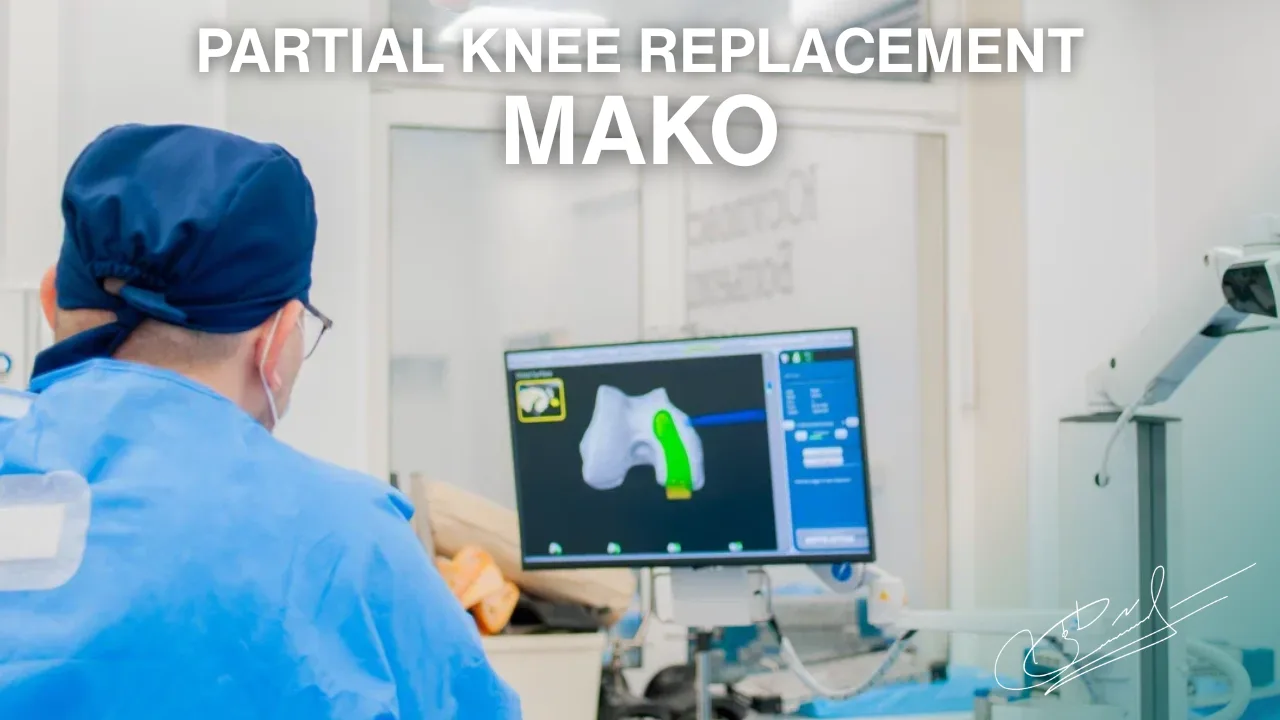
Mako Robot in Unicompartmental Knee Replacement
When Only Part of the Knee Joint is Affected
The knee joint consists of several compartments that distribute load during movement. In some cases, degenerative changes affect not the entire joint, but only one part of it. In such situations, pain and limited mobility may be associated with wear in a specific area of the joint surface.
If the damage is localized, the physician may consider a surgical option in which only the affected part of the joint is replaced rather than the entire joint.
This type of surgical treatment is called unicompartmental knee replacement. More details can be found on the unicompartmental knee replacement page.
Conditions Where Partial Joint Replacement is Used
The most common reason for this type of surgery is knee osteoarthritis, where cartilage degeneration primarily affects one compartment.
In the early stages of the disease, conservative treatment methods may be used. However, as the condition progresses, pain and restricted movement can become more pronounced.
More information about disease progression can be found in the article “Knee Osteoarthritis: How the Disease Develops and When Surgery May Be Needed.”
How Partial Replacement Differs from Total Replacement
The main difference between these procedures lies in the extent of the intervention.
In total knee replacement, all joint surfaces are replaced. In unicompartmental replacement, only the damaged area is treated, while the remaining joint structures are preserved.
More details about total joint replacement can be found on the total knee replacement page.
The choice of method depends on the condition of the joint structures, the degree of deformity, and the overall state of the knee.
How the Mako Robot is Used in Partial Replacement
Modern technologies allow surgical parameters to be planned in advance. In such cases, the Mako robotic system may be used.
It helps the surgeon analyze computed tomography (CT) data and create a digital model of the patient’s knee joint.
More details about how the technology works can be found on the Mako robot page.
Surgical Planning
Before surgery, joint anatomy is analyzed using a three-dimensional model. This allows the surgeon to evaluate bone structure and determine optimal implant positioning.
During planning, the following factors are considered:
- anatomical shape of joint surfaces
- limb alignment
- parameters of the future implant
More details about digital planning can be found in the article “3D Surgical Planning Using the Mako Robot.”
Role of the Mako Robot During Surgery
During the procedure, the robotic system is used as a navigation tool. It helps the surgeon follow preplanned parameters and control instrument positioning.
This allows:
- precise preparation of bone surfaces
- control of implant placement
- adherence to the planned geometry of implant positioning
More details on the importance of accuracy can be found in the article “Why Implant Positioning Accuracy Depends on Planning: The Role of the Mako Robot.”
Who May Be Suitable for Unicompartmental Replacement
Partial knee replacement is not suitable for all patients. The possibility of performing this procedure is determined after evaluating the condition of the joint.
The physician assesses:
- location of the damage
- condition of the ligament structures
- degree of joint deformity
Based on these factors, the optimal treatment strategy is selected.
Postoperative Recovery
After surgery, the recovery phase begins. Its goal is to restore joint mobility and gradually return function to the limb.
Rehabilitation typically includes exercises to improve knee mobility, strengthen muscles, and restore normal gait.
The rehabilitation program is tailored individually and depends on the specifics of the procedure and the patient’s condition.
Why Accuracy is Especially Important in Partial Replacement
In unicompartmental knee replacement, most of the native joint is preserved. Therefore, correct implant positioning is particularly important for joint stability.
Accurate component placement helps maintain natural knee biomechanics and ensures more even load distribution.
Unicompartmental knee replacement is used when damage affects only one compartment of the knee joint. This approach preserves healthy joint structures and helps restore function.
The use of the Mako robotic system enables more precise surgical planning and implant placement, improving the predictability of treatment outcomes.
