

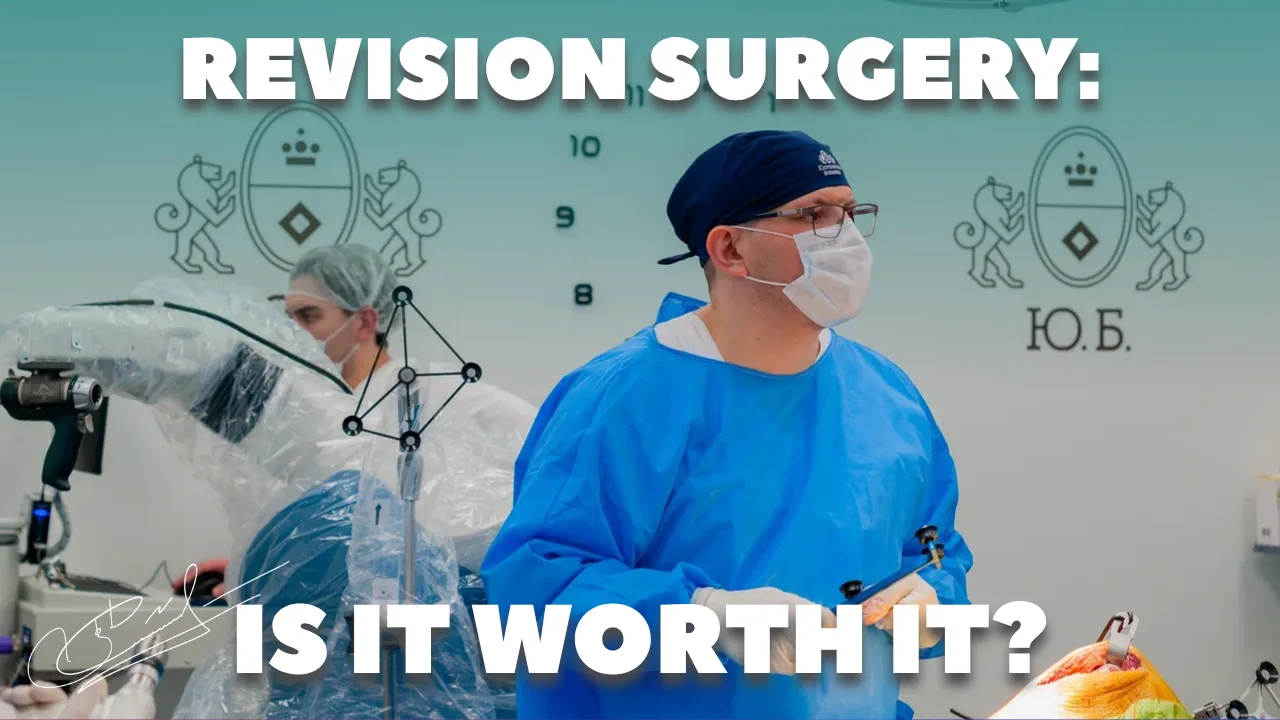
Revision joint surgery: when should the strategy be reconsidered?
Revision hip arthroplasty is a more complex stage of surgical treatment compared to primary surgery. It requires precise diagnostics, understanding the causes of an unsatisfactory outcome, and detailed planning.
A repeat operation must be strictly justified.
Why revision becomes necessary
The main reasons for revision include:
• instability or dislocation;
• wear or loosening of components;
• pain of unclear origin;
• incorrect implant positioning;
• infection-related complications.
It is important not only to identify the problem, but also to determine its source. In some cases, symptoms are related not to the implant itself, but to soft tissues or pelvic biomechanics.
The role of diagnostics
Before making a decision, a comprehensive assessment is performed:
• X-rays in multiple projections;
• CT scans to evaluate component positioning;
• laboratory tests if infection is suspected;
• clinical examination and functional testing.
Errors in interpretation may lead either to overly aggressive treatment or to unjustified delay.
(For more details, see “Errors in interpreting MRI and CT scans of joints.”)
Is repeat surgery always necessary?
Not every case of pain after joint replacement requires revision.
In some cases, the issue can be managed with:
• adjustment of rehabilitation;
• medication;
• targeted local treatments.
The decision is based on a combination of factors, not a single symptom.
(If expert opinions differ, see “Different doctors, different opinions: who should you trust?”)
Importance of approach selection
When planning revision surgery, the extent of the required correction is carefully considered. In selected cases, an anterolateral intermuscular technique may be used if the clinical situation allows.
The minimally invasive anterolateral intermuscular Röttinger approach may be considered under specific indications and anatomical conditions.
When a second opinion is justified
Re-evaluating the strategy is especially advisable if:
• a major revision is planned;
• the diagnosis is uncertain;
• chronic pain persists without a clear cause;
• recommendations from specialists differ.
An independent clinical evaluation is available on the page “Treatment Review (Second Opinion).”
Revision surgery requires a balanced and well-reasoned decision.
Comprehensive diagnostics and expert evaluation help minimize risks and define the optimal treatment strategy.
The primary goal is not simply to replace a component, but to restore joint stability and function.
