

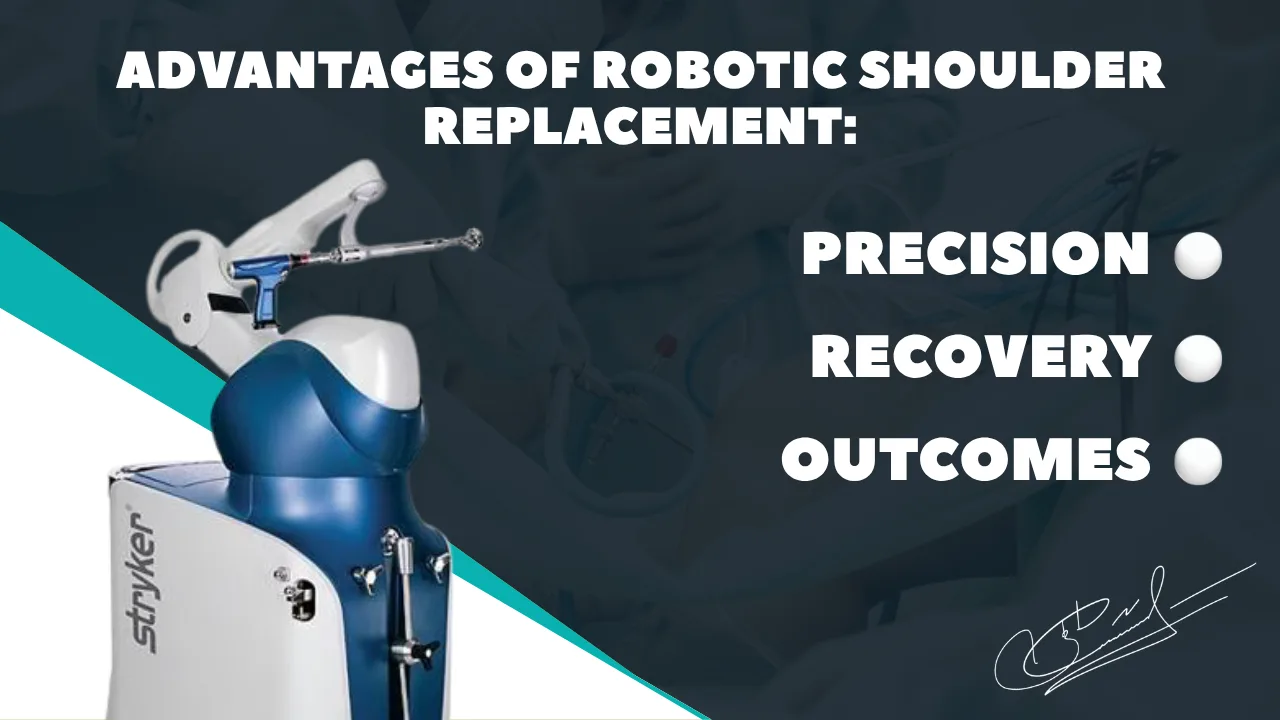
When it comes to robotic shoulder arthroplasty, the conversation almost always starts with the word “accuracy.” This is logical, but in real clinical practice, things are a bit more complex. For both the surgeon and the patient, it is important not only how precisely the implant is placed, but also how the joint will function after surgery — in a month, a year, or several years.
From this perspective, it makes sense to discuss the application of the MAKO SmartRobotics™ system.
(The technical surgical process is detailed in the article: “How the MAKO Robot Works in Shoulder Replacement: Step by Step.”)
Why Accuracy Is Especially Critical in the Shoulder
The shoulder is inherently unstable. A large range of motion is achieved at the cost of reduced bony stability. Therefore, any deviations in the placement of the glenoid component are felt much more than, for example, in the knee.
In practice, this often looks like:
The patient formally has a “well-performed surgery,” but still experiences pain, joint instability, or limited motion.
Investigation often reveals that the cause is the orientation of the components.
Robotic assistance does not eliminate all problems, but it allows the surgeon to control precisely what truly depends on them.
What Robotics Offers the Surgeon in Practice
Some argue that an experienced surgeon does not need a robot. This is partly true.
However, the key question is not whether the surgeon can perform the operation well, but how consistently they can reproduce the same result in complex cases.
MAKO helps to:
Maintain pre-planned implant angles
Avoid excessive bone resection
Work more confidently in cases of glenoid deformity
From experience: in complex anatomical situations, the sense of control over the procedure becomes crucial. The robot does not command—it protects.
Impact on Recovery: Realistic, Yet Honest
Patients often expect robotic surgery to automatically mean faster and easier recovery. This is not entirely true. Recovery after shoulder arthroplasty depends on muscle and tendon condition, the extent of the surgery, and adherence to rehabilitation protocols.
However, there is an important point:
When the implant components are positioned as accurately as possible and joint biomechanics are close to anatomical, recovery becomes more predictable. Unexplained pain is less common, load can be applied more safely, and rehabilitation programs are easier to plan.
This is not a “magical technology effect,” but a consequence of correct mechanics.
Prognosis and Implant Longevity
In the long term, the orientation of the components often determines the fate of the prosthesis. Incorrect positioning of the glenoid component increases stress on the fixation area and may lead to premature wear or loosening.
Robotic assistance allows:
Preservation of more bone
Reduced risk of technical errors
Potential improvement in prosthesis longevity
It is still too early to report decade-long results specifically for MAKO Shoulder, but experience with robotic knee and hip arthroplasty shows that this logic is effective.
When Robotic Assistance Is Truly Justified
It is important to understand: robotics is not needed for every surgery or every patient.
In straightforward clinical cases, traditional techniques remain effective and reliable.
MAKO provides the most benefit in cases of:
Significant glenoid deformity
Post-traumatic changes
Revision surgeries
Non-standard anatomy
(Clinical examples from the first surgeries are discussed in the article: “First MAKO Shoulder Surgeries: Experience in Australia and the USA.”)
Robotic shoulder arthroplasty is not about trends or replacing the surgeon. It is about control, reproducibility, and reducing technical risks where the cost of an error is particularly high.
MAKO SmartRobotics™ does not guarantee a perfect outcome, but it helps make a good result more consistent. For the shoulder joint, this is precisely what matters most.
