

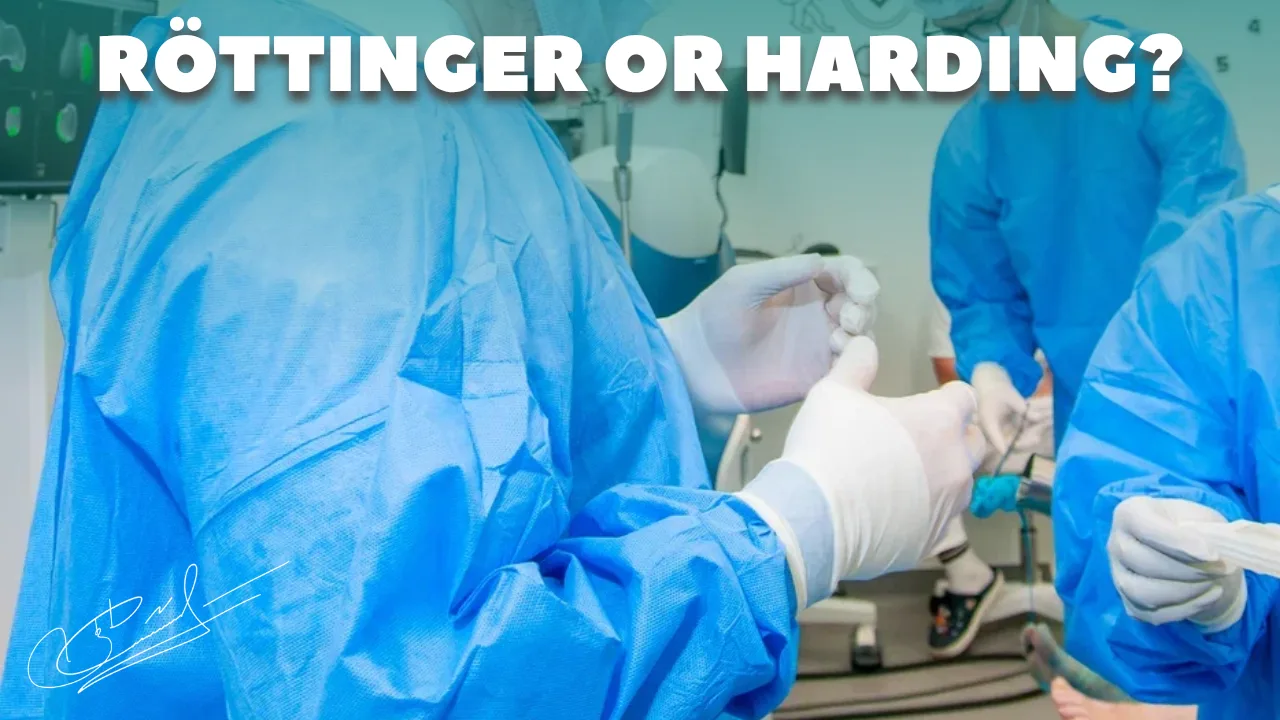
Röttinger or Harding: what is the key difference between anterolateral approaches?
In hip surgery, the name of the approach defines not only the incision line, but also the strategy of working with the muscles. Among anterolateral approaches, the most commonly compared are the Harding approach and the Röttinger approach.
At first glance, they are anatomically similar. In practice, the differences are fundamental.
Anatomical principle
The classic Harding approach involves partial detachment of the gluteus medius muscle to achieve sufficient visualization of the joint. This provides good surgical exposure but affects elements of the abductor mechanism.
The Röttinger approach, in contrast, is based on using an intermuscular interval without detaching the gluteus medius. The procedure is performed strictly within a natural anatomical plane between muscle structures.
(Historical development is discussed in the article “How the Röttinger approach evolved: the history of anterolateral techniques”)
Functional implications
The gluteus medius plays a key role in stabilizing the pelvis during walking. Its partial damage may influence:
• the intensity of postoperative pain;
• the risk of limping;
• the speed of gait recovery;
• the sense of stability in the early postoperative period.
With an intermuscular approach, the risk of functional deficit is lower due to preservation of the anatomical integrity of the muscle complex.
(For a biomechanical explanation, see “Why the intermuscular approach reduces the risk of limping after surgery”)
Technical differences
Harding approach:
• partially muscle-detaching;
• provides wider exposure;
• familiar to many surgeons.
Röttinger approach:
• fully intermuscular;
• requires precise anatomical orientation;
• allows for more tissue-sparing technique.
It is important to emphasize that the choice of approach always depends on the clinical situation and the surgeon’s experience. No method is universally “better” outside the context of a specific patient.
When the intermuscular principle matters most
Preservation of muscle balance is especially important in cases of:
• an active lifestyle;
• the need for faster rehabilitation;
• high demands on gait stability;
• bilateral joint replacement.
In such cases, a tissue-sparing anatomical approach can play a significant role.
At our center, we use the minimally invasive anterolateral intermuscular Röttinger approach as a muscle-preserving technique that maintains the integrity of the abductor mechanism.
The comparison between the Harding and Röttinger approaches is not a debate of “old vs new,” but a matter of surgical philosophy in working with soft tissues.
Harding — a partially muscle-detaching approach with broad exposure.
Röttinger — an intermuscular technique focused on preserving function.
The key factor is not just the name of the method, but a clear understanding of its anatomical logic and clinical indications.
