

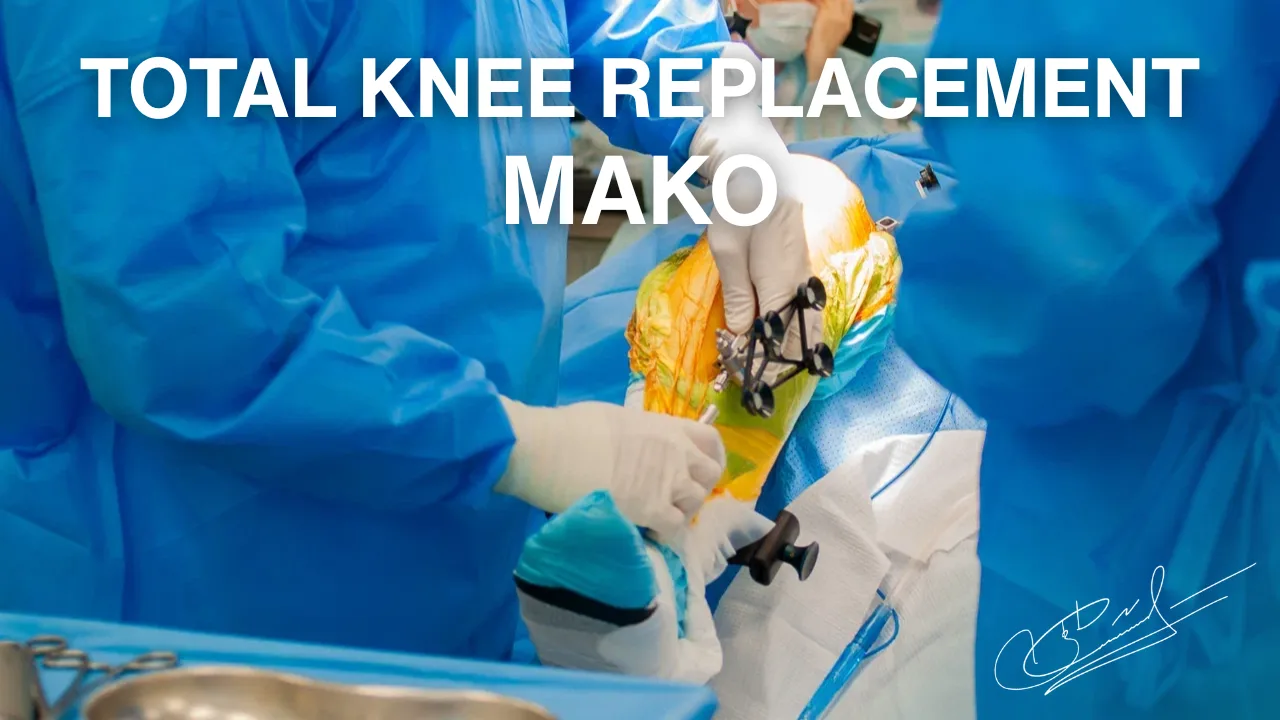
Total Knee Replacement with the Mako Robot
When Total Knee Replacement is Required
The knee joint performs complex functions during movement. It provides stability during walking, climbing stairs, and other daily activities. With advanced joint damage, movement can become painful, and mobility gradually decreases.
One of the most common reasons for surgery is knee osteoarthritis. As the disease progresses, the joint cartilage gradually deteriorates, which may lead to pain, stiffness, and joint deformity.
More information about disease progression can be found in the article “Knee Osteoarthritis: How the Disease Develops and When Surgery May Be Needed.”
If the joint is significantly damaged, total joint replacement may be considered. More details about this treatment method can be found on the total knee replacement page.
What Total Knee Replacement Is
Total knee replacement is a procedure in which damaged joint surfaces are replaced with artificial components.
During the operation, the surgeon removes the affected areas of bone and installs prosthetic components that replicate the shape of the joint surfaces and restore knee movement.
This method is used when multiple compartments of the joint are affected and preserving native structures is no longer possible.
How the Mako Robot Is Used in Total Knee Replacement
Modern technologies allow surgical parameters to be planned in advance. The Mako robotic system may be used for this purpose.
It analyzes computed tomography (CT) data and helps create a digital model of the patient’s knee joint.
More details about the technology can be found on the Mako robot page.
The use of a digital model allows the surgeon to calculate implant positioning in advance and evaluate patient-specific anatomical features.
How the Procedure is Planned
Before surgery, a detailed analysis of joint anatomy is performed. A three-dimensional model of the knee is created based on CT imaging.
This allows the surgeon to:
- assess the shape of bone structures
- determine prosthetic component positioning
- define the optimal limb alignment
More details about planning can be found in the article “Mako Robot and 3D Surgical Planning.”
How the Mako Robot Assists During Surgery
During the procedure, the robotic system is used as a navigation tool. It helps the surgeon control instrument positioning and follow preplanned parameters.
This allows:
- precise preparation of bone surfaces
- control of implant positioning
- adherence to planned implant alignment parameters
More details on the importance of accuracy can be found in the article “Mako Robot and Implant Positioning Accuracy.”
Why Accuracy is Especially Important in Total Knee Replacement
In total knee replacement, it is essential to restore proper limb alignment and achieve soft tissue balance.
Correct positioning of implant components helps ensure joint stability and more natural biomechanics of movement.
Accurate implant positioning also allows for more even load distribution within the joint.
Can the Robot Perform the Surgery Independently?
Despite the use of robotic technology, the procedure is performed by the surgeon. The Mako system acts as an assisting navigation tool.
All decisions during the procedure are made by the surgeon, who controls the instruments and manages the operation.
Postoperative Recovery
After joint replacement, the recovery phase begins. Its goal is to restore knee mobility and overall limb function.
Rehabilitation includes exercises to improve knee movement, strengthen muscles, and gradually return to normal activity.
The recovery program is individualized and depends on the condition of the joint and the specifics of the procedure.
When Robotic Technology is Especially Useful
The use of robotic systems can be particularly beneficial when maximum precision in implant positioning is required.
For example:
- significant knee deformities
- complex bone anatomy
- need for precise limb alignment
In such cases, digital planning and navigation help the surgeon perform the procedure more accurately.
Total knee replacement is used in cases of advanced joint damage when other treatment methods are no longer effective.
The use of the Mako robotic system helps the surgeon plan surgical parameters in advance and control implant positioning during the procedure, contributing to greater accuracy and more predictable treatment outcomes.
