

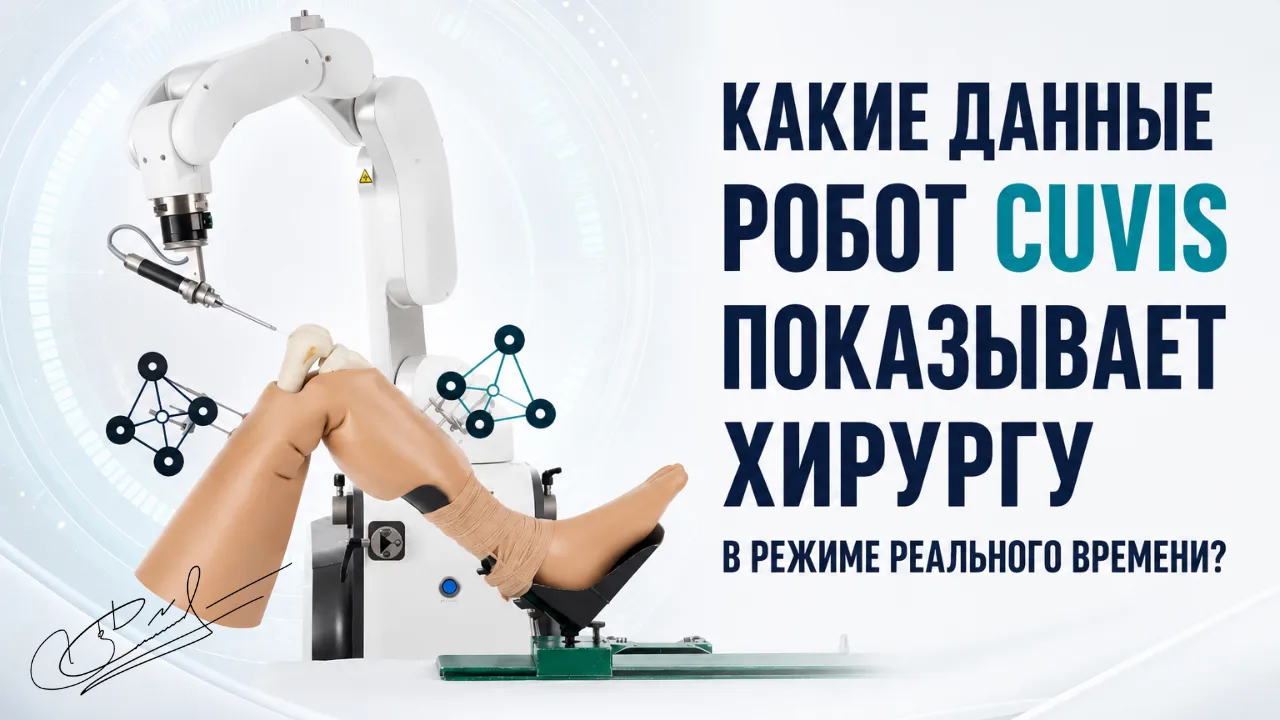
What Data CUVIS Shows the Surgeon in Real Time
The main difference between modern robotic systems and traditional navigation tools is the amount of information the surgeon receives during the operation. Data has become one of the main reasons robotic joint replacement has developed so actively.
During knee replacement, the doctor must consider many parameters at the same time. Some are related to limb alignment, some to soft tissue function and some to joint motion. Modern robotic platforms can display different indicators in real time and help the surgeon use them during the procedure.
CUVIS is a technology focused on working with this type of information.
Mechanical axis data
One of the most important parameters is the mechanical axis of the lower limb.
In advanced osteoarthritis, the leg axis often changes. Some patients develop varus alignment, in which the knee deviates outward visually. Others develop valgus alignment.
During surgery, the surgeon needs to understand the initial parameters and assess changes at different stages of the procedure. Data about the limb axis is therefore one of the key indicators used in robotic joint replacement.
Implant component position data
After implant placement, the position of each component matters.
This is not only about choosing implant size. It also concerns the spatial position of components relative to the patient's anatomy. Modern robotic systems allow the surgeon to work with parameters related to component position inside the joint.
These data are used as part of the overall assessment of the operation.
Ligament balance data
The knee is not only bones and an implant. The ligament system plays a major role in how the joint works.
Even a well-positioned implant functions inside a complex soft-tissue system. Ligament balance and its interaction with the joint therefore remain important areas of analysis.
Modern robotic platforms can provide information related to soft-tissue balance at different stages of the operation.
Joint motion data
The knee does not move only by simple flexion and extension. It performs complex movements involving bones, ligaments and muscles.
Modern orthopedics therefore pays close attention to kinematics, meaning the characteristics of joint motion.
Robotic systems help analyze parameters related to knee motion and give the surgeon a more complete picture of how the joint functions.
Range of motion data
Range of motion remains another important parameter.
The surgeon needs to understand how the knee behaves in different positions and how joint parameters change during flexion and extension.
These measurements form part of the overall picture used during surgery.
Why are these data considered together?
Each indicator has limited value on its own. Modern joint replacement views the knee as one biomechanical system.
Mechanical axis, component position, ligament balance, kinematics and range of motion are interconnected. A change in one parameter can influence the others, so the surgeon analyzes them as a whole.
CUVIS provides the surgeon with information about the mechanical axis, implant component position, ligament balance, knee motion and other parameters that matter during surgery.
Working with these data distinguishes modern robotic technologies from traditional approaches and makes digital navigation one of the most actively developing areas in knee replacement.
