

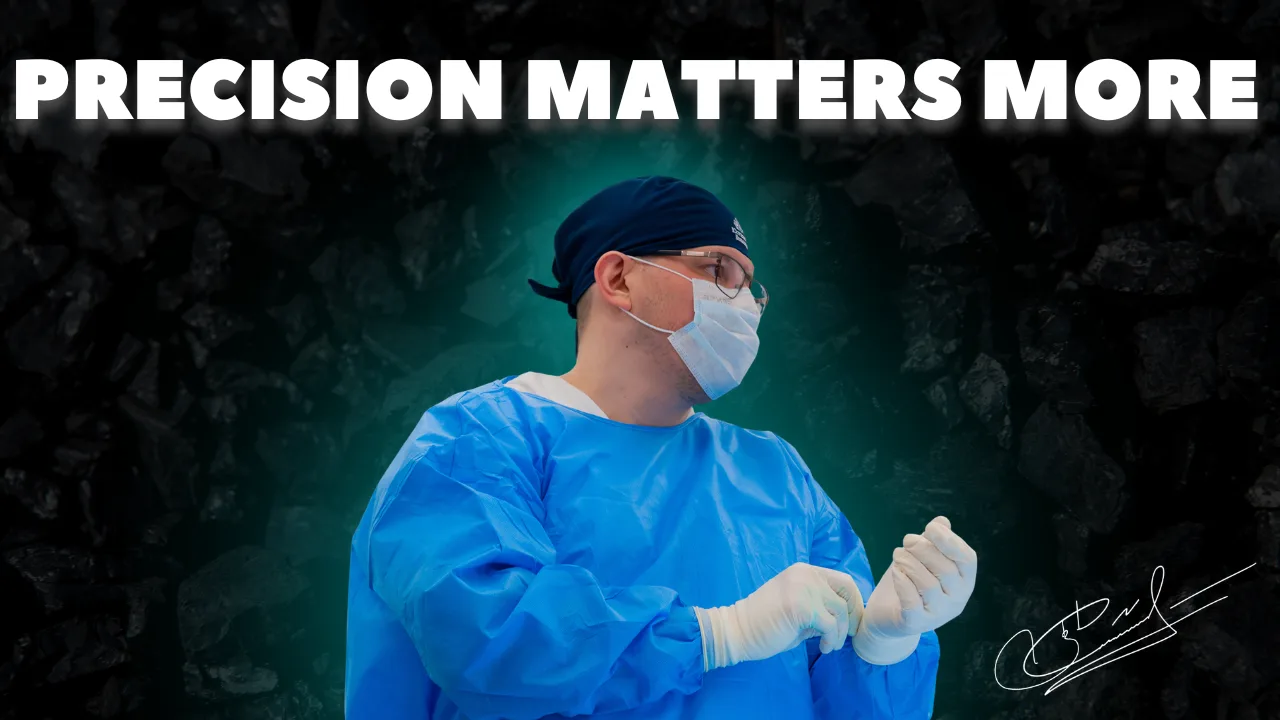
Why surgical precision matters more than incision size
Why patients often focus on incision length
When a patient is advised to undergo joint surgery, one of the first questions is often: “How big will the incision be?” In recent years, minimally invasive techniques have been widely discussed, leading many patients to assume that a smaller incision means an easier and safer operation.
In reality, the length of the skin incision is only one technical aspect of the surgical approach. It is not the primary factor determining the outcome. What matters far more is surgical precision and accurate implant positioning.
What truly determines the outcome of surgery
In joint replacement, precision is critical.
The surgeon must properly prepare the bone, position the implant components at specific angles, and ensure joint stability. Even small deviations in implant positioning can affect joint function, gait, and implant longevity over time.
For this reason, modern orthopedics focuses not on incision size, but on accuracy and control at every stage of the procedure.
Why a smaller incision does not always mean a better operation
Minimally invasive techniques can indeed reduce soft tissue trauma. However, excessively limiting the incision may restrict visibility of the surgical field.
If anatomical structures are not clearly visualized, it becomes more difficult to perform precise maneuvers. In such cases, the priority remains safety and accurate implant placement — not minimizing the incision at all costs.
An experienced surgeon always chooses the approach that allows the most precise and controlled execution of the procedure.
The role of modern surgical approaches
Modern arthroplasty techniques aim not only to reduce incision size, but also to preserve muscles and soft tissues.
For example, intermuscular approaches allow the surgeon to work between muscles without damaging them. This helps maintain muscle function and supports faster recovery.
(For more details, see “Why the intermuscular approach reduces the risk of limping after hip replacement.”)
When minimally invasive techniques are truly beneficial
Minimally invasive approaches are effective when they allow the surgeon to perform all stages of the procedure safely and accurately.
The key condition is maintaining adequate visualization while handling tissues gently. Reducing incision size should not compromise surgical control or implant positioning accuracy.
In modern orthopedics, certain techniques combine a relatively small incision with high procedural accuracy. This is achieved through anatomically optimized approaches that allow surgeons to work between muscles without damaging them.
One such technique is the anterolateral intermuscular Röttinger approach. In this method, the surgeon operates between muscle structures, preserving their integrity. This reduces soft tissue trauma, maintains muscle function, and allows precise control of implant positioning.
Thus, this approach combines several important factors: a relatively small skin incision, muscle preservation, and the ability to perform the procedure with high precision.
(For more details, see “Who is the minimally invasive anterolateral intermuscular Röttinger approach suitable for?”)
What to consider when choosing surgery
When planning surgery, it is important to discuss not only incision size, but also:
• accuracy of implant positioning;
• surgeon’s experience;
• chosen surgical approach;
• condition of muscles and bone;
• individual patient factors.
All of these factors have a much greater impact on outcomes than the length of the skin incision.
Incision size often becomes a focus because it is visible and easy to compare. However, in real surgical practice, precision is far more important.
Accurate implant positioning, preservation of soft tissues, and appropriate choice of surgical approach play a decisive role in joint function and recovery quality.
Therefore, when choosing a treatment method, it is more important to focus on surgical expertise and precision rather than incision length.
