

The Hardinge approach in hip replacement: what patients should know
Before hip replacement, patients often ask how the surgeon will perform the operation. The chosen approach determines which tissues the surgeon passes through to reach the joint and what will need to recover after the implant is placed. The Hardinge approach is a long-established direct lateral, or side, approach. It provides good access to the joint but involves part of the muscles that help maintain balance during walking.
How the surgeon reaches the joint
With the Hardinge approach, the surgeon works through the anterior part of the hip abductor muscles. These muscles lie to the side of the hip and are involved in every step: they keep the pelvis level as body weight shifts onto one leg. After the implant is placed, the affected tissues are repaired, followed by a gradual recovery of strength and the usual walking pattern.
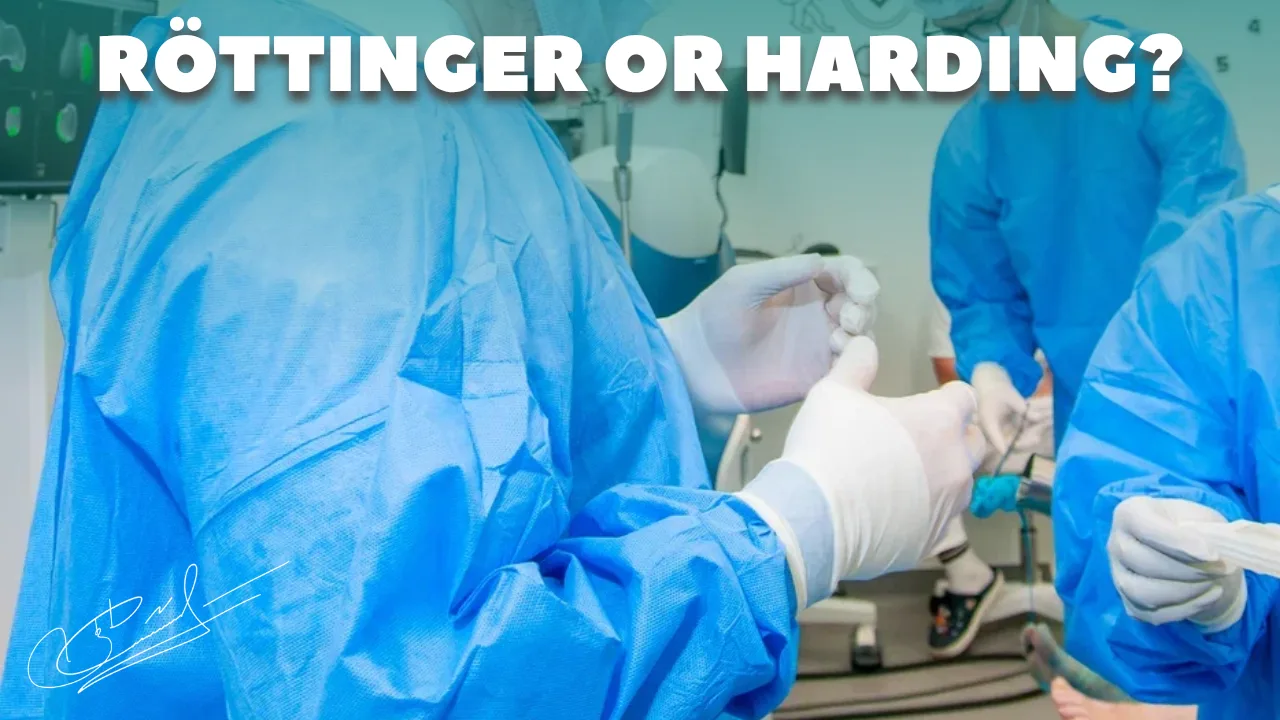
By comparison, with the Röttinger approach the surgeon passes through a natural interval between muscles, preserving the main part of the gluteus medius. The two approaches are therefore not different names for the same operation. They reach the same joint but differ in how the surrounding tissues are handled. This distinction is explained in more detail in a separate article on this website.
Why a limp may develop after the Hardinge approach
The gluteus medius helps a person walk evenly and steadily. Because the Hardinge approach involves part of the abductor muscles, they need time to recover after surgery. While strength returns, the patient may notice a limp or feel that the operated leg is less stable. This is one reason why medical follow-up and appropriately selected rehabilitation are important after hip replacement.
The superior gluteal nerve runs in this region and helps control these muscles. Injury to it is a possible complication of the direct lateral approach and can also cause muscle weakness. This is a risk, not an inevitable outcome of surgery. If a limp persists or worsens, the doctor assesses the cause during an examination: the symptom alone cannot establish whether it is related to a muscle, a nerve or another aspect of recovery. Review of surgical approach complications.
Are thigh numbness and burning the same risk?
No. These symptoms involve a different nerve. Numbness, tingling or burning of the skin on the outer thigh may result from irritation of the lateral femoral cutaneous nerve. This complication is particularly well described for DAA, the direct anterior approach. Hardinge is a direct lateral approach, so the risks associated with the two should not be confused, nor should skin numbness be described as a characteristic consequence of Hardinge. Review of nerve complications.
Any new or worsening change in sensation after surgery should be discussed with the treating doctor. The patient's experience matters, but an examination is needed to establish its cause.
What research shows
In a study directly comparing Hardinge with Röttinger, surgery using Hardinge took less time but involved greater blood loss. At one year, researchers found no significant difference between the groups in joint function scores or gait-analysis findings. Differences between the approaches may therefore be more noticeable during surgery and early recovery than a year later. Study by Martin and colleagues.
In a 2026 systematic review, the Hardinge approach was compared with the posterolateral approach. Implant dislocations were less frequent in the Hardinge group, while abductor strength and walking speed were better in the posterolateral group. The authors caution that the findings may have been affected by differences between patients, implants and surgical techniques, as well as the approaches themselves. These data help inform discussion of the method's advantages and limitations but do not replace individual planning. 2026 systematic review.
What recovery involves
After the implant is placed, the patient begins moving according to a plan set by the treating team. The doctor determines the permitted level of weight-bearing, while a rehabilitation specialist helps restore muscle strength and an even walking pattern. Timing depends on the person's condition and the operation: the name of the approach alone cannot predict the day when walking without support will be possible.
During recovery after the Hardinge approach, particular attention is paid to the muscles that keep the pelvis level during walking. Patients should perform prescribed exercises and tell their doctor if their limp worsens, new marked pain develops or bearing weight on the leg becomes difficult. This allows the joint to be assessed promptly and the rehabilitation plan adjusted if necessary.
The Hardinge approach provides good access to the hip during implant placement. It involves part of the hip abductor muscles, which support a stable walking pattern. These muscles need to recover after surgery, so walking and exercises are supervised by specialists. Understanding this feature helps patients know what rehabilitation will focus on and which questions to discuss with the surgeon beforehand.