

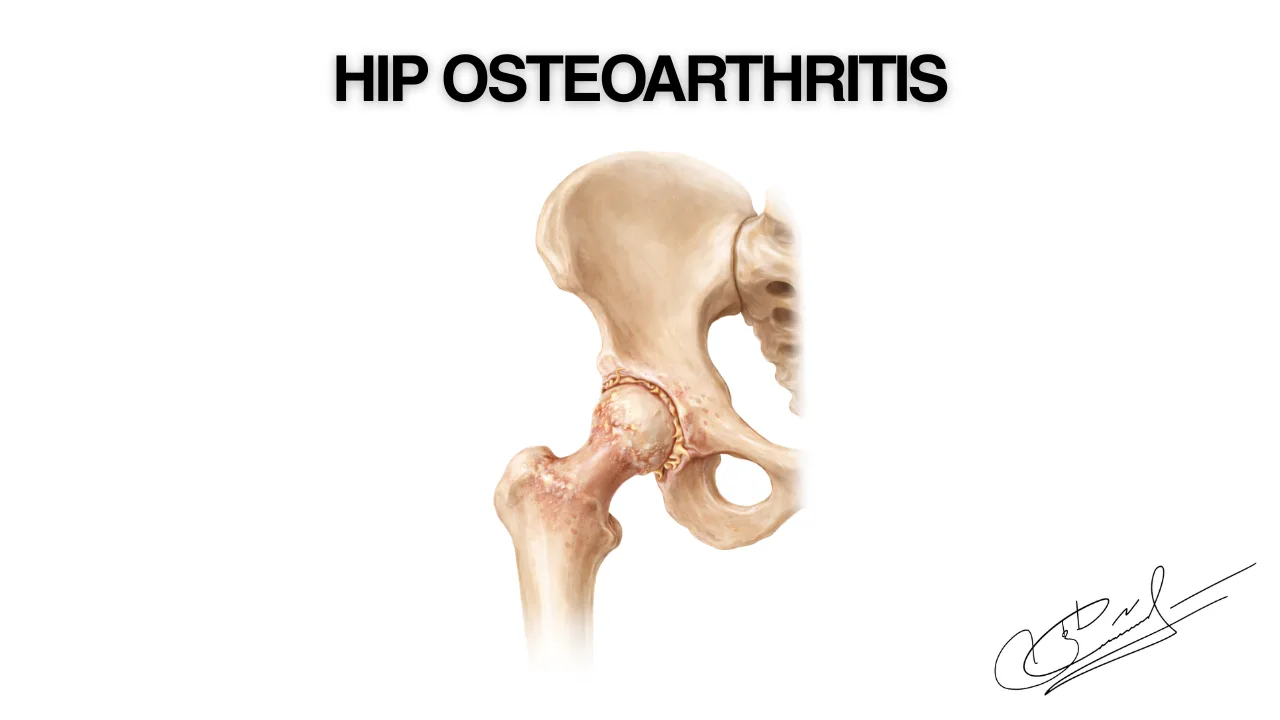
Hip osteoarthritis: how the condition develops and what treatment options are available
The hip joint is one of the most heavily loaded joints in the human body. It enables movement during walking, climbing stairs, bending, and turning. When the structure of the joint begins to change, a condition known as hip osteoarthritis gradually develops.
In this condition, the articular cartilage progressively wears down. As a result, the joint surfaces no longer move smoothly, which may lead to discomfort and limited mobility. Over time, not only the cartilage but also other joint structures may be affected.
(For more details on the mechanisms of disease development, see “Osteoarthritis of the joints.”)
Symptoms that may indicate a problem
The condition usually develops gradually. In the early stages, symptoms may be subtle and often overlooked.
Common patient complaints include:
— discomfort in the groin or upper thigh
— pain during prolonged walking
— stiffness after rest
— reduced range of motion
— difficulty climbing stairs or rising from a chair
Pain may sometimes radiate to the knee or lower back. In such cases, patients do not always immediately associate the symptoms with the hip joint.
How osteoarthritis progresses
The disease does not occur suddenly. Changes in the joint typically develop over time.
In the early stages, symptoms may be minimal and appear only after physical activity. As the condition progresses, pain intensifies and mobility becomes increasingly limited.
(For more details, see “Stages of osteoarthritis.”)
Non-surgical treatment
If osteoarthritis is detected at an early stage, conservative treatment methods are often used. Their goal is to reduce symptoms and maintain joint function.
These may include:
— targeted exercises
— load modification
— medication therapy
— physiotherapy
In some cases, these measures are sufficient to control the condition.
(For more details, see “Can osteoarthritis be treated without surgery?”)
When surgery is considered
If the disease continues to progress and pain becomes persistent, significantly affecting quality of life, surgical treatment may be recommended.
One of the most effective methods for advanced osteoarthritis is hip replacement. During the procedure, damaged joint structures are replaced with an artificial implant.
Why the surgical technique matters
The outcome of surgery depends not only on the implant, but also on the surgical technique.
Modern orthopedic approaches allow surgeons to operate between muscle structures without damaging them. This can reduce soft tissue trauma and support faster recovery.
(For more details, see “Why the intermuscular approach reduces the risk of limping after hip replacement.”)
The role of modern technologies
In recent years, digital planning systems and robotic technologies have been increasingly used in orthopedics.
These technologies help surgeons prepare more accurately and control implant positioning during the procedure. One example is the MAKO robotic system used in joint replacement.
Hip osteoarthritis is a condition that develops gradually and may eventually limit daily activity.
In early stages, conservative treatment is often effective. When the disease becomes advanced, surgical intervention may be required.
Modern arthroplasty techniques and high-precision technologies allow effective restoration of joint function and help patients return to their normal level of activity.
