

Knee osteoarthritis: how the condition develops and when surgery may be needed
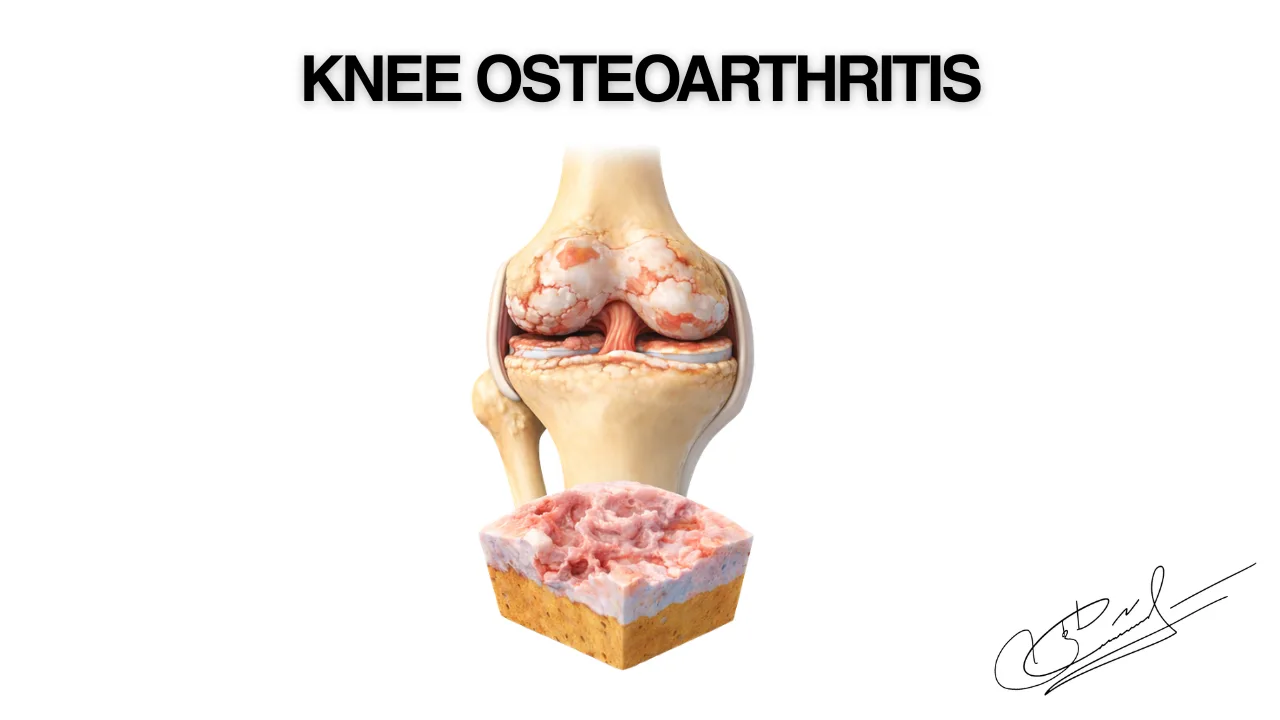
Knee osteoarthritis is a condition in which the structure of the joint gradually changes and the cartilage deteriorates. As a result, the joint becomes less effective in performing its function, and movement may be accompanied by discomfort or pain.
The knee is constantly involved in movement. It bears load during walking, climbing stairs, squatting, and many other activities. As the protective cartilage layer gradually wears down, the joint surfaces no longer move smoothly, which can lead to discomfort and reduced mobility.
(For more details on the mechanisms of these changes, see “Osteoarthritis of the joints.”)
How knee osteoarthritis develops
Changes in the joint develop gradually. In the early stages, the condition may cause little to no discomfort.
Over time, load distribution within the joint changes, and cartilage loses its ability to function as an effective shock absorber. The body may respond with changes in bone structures and joint surfaces.
As the condition progresses, joint movement may become increasingly restricted.
Common symptoms of knee osteoarthritis
Symptoms may vary between patients, but the most common include:
— discomfort in the knee during walking or physical activity
— stiffness after periods of rest
— a grinding or clicking sensation during movement
— reduced ability to bend or straighten the knee
— decreased endurance during prolonged walking
In later stages, pain may occur even at rest.
Stages of the condition
Knee osteoarthritis develops in several stages.
In early stages, changes may be minimal and have little impact on daily activity. As the disease progresses, cartilage deteriorates and joint surfaces become increasingly altered.
In advanced stages, joint function may be significantly impaired.
(For more details, see “Stages of osteoarthritis.”)
Can osteoarthritis be treated without surgery?
In early stages, conservative treatment methods are often used. Their goal is to reduce symptoms and maintain joint function.
These may include:
— therapeutic exercises
— load modification
— medication therapy
— physiotherapy
These approaches can be effective in the initial stages of the disease.
(For more details, see “Can osteoarthritis be treated without surgery?”)
When surgery may be needed
If the condition continues to progress and conservative treatment is no longer effective, surgical treatment may be considered.
Surgery may be recommended when:
— pain becomes persistent
— joint movement is significantly limited
— the condition interferes with daily activities
Knee replacement surgery
In advanced osteoarthritis, one of the most effective treatment options is knee replacement.
During the procedure, damaged joint surfaces are replaced with artificial components that restore movement and reduce pain.
Modern technologies in orthopedics
Modern orthopedics increasingly uses digital planning and robotic systems.
These technologies allow surgeons to plan procedures more accurately and control implant positioning. One example is the MAKO robotic system used in joint replacement.
How the decision for surgery is made
Treatment strategy is always individualized. The doctor considers the degree of joint damage, severity of symptoms, and the impact on the patient’s quality of life.
If there is uncertainty about the need for surgery, it is important to understand the criteria used in decision-making.
(For more details, see “You’ve been advised to undergo surgery: how to know if it’s really necessary?”)
Knee osteoarthritis develops gradually and may initially present with only mild discomfort. However, as the condition progresses, symptoms can intensify and limit daily activity.
In early stages, conservative treatment is used. In more advanced cases, surgical intervention may be considered.
Modern arthroplasty techniques and high-precision technologies allow restoration of joint function and significant improvement in quality of life.
