

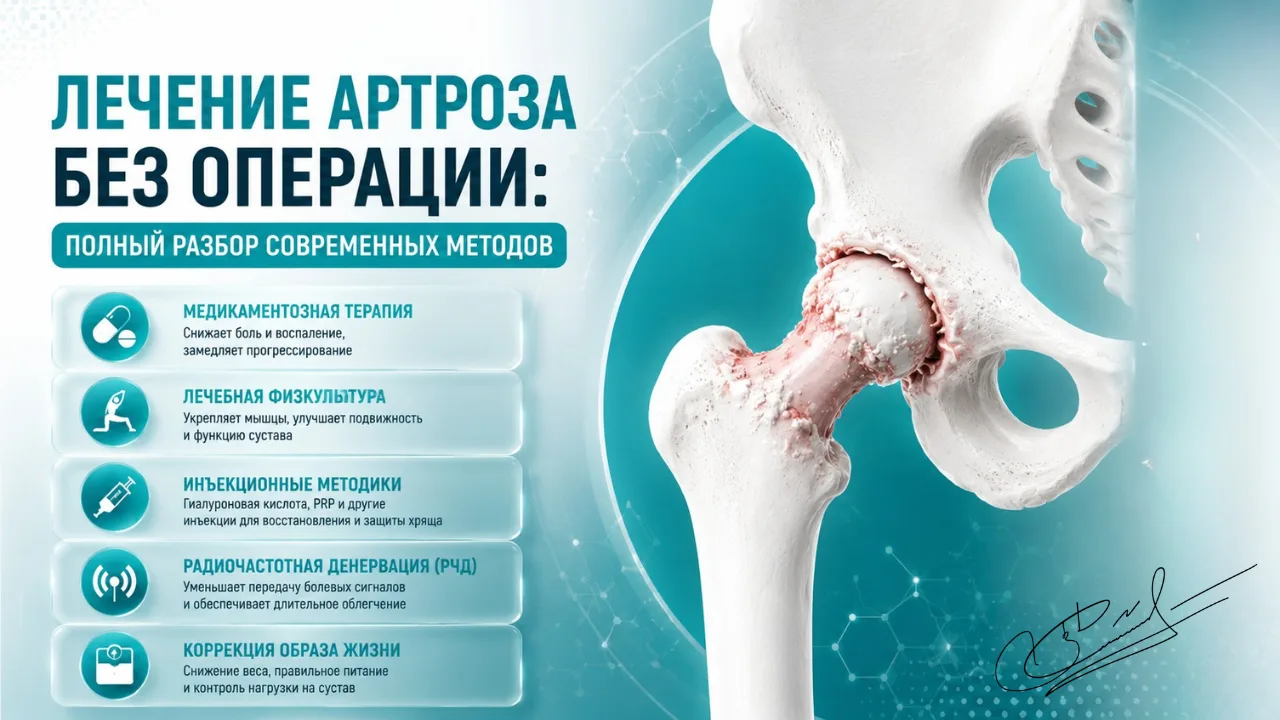
Non-Surgical Treatment of Osteoarthritis: A Complete Guide to Modern Methods
When patients hear the diagnosis of osteoarthritis, many immediately think about inevitable surgery. It can seem as if the disease always follows the same path: painkillers first, then repeated injections, and finally joint replacement. In reality, modern treatment is much more nuanced. In many cases, the progression of symptoms can be slowed, pain can be reduced and normal activity can be preserved for a long time without surgery.
It is important to understand that osteoarthritis is a chronic disease, and there is still no universal method that can make it disappear completely. This does not mean that a patient is doomed to live with constant pain. Today, physicians have a range of methods that target different mechanisms of the disease: inflammation, muscle weakness, excessive joint load and chronic pain signaling. A combination of these methods usually works better than any single "miracle" procedure.
Why osteoarthritis affects more than cartilage
For many years osteoarthritis was described mainly as wear of the articular cartilage. We now know that almost every structure of the joint is involved.
As the disease progresses, cartilage becomes thinner, the bone beneath the joint surface changes, bony outgrowths may appear, synovial fluid quality decreases, the joint capsule loses elasticity and the surrounding muscles gradually weaken. That is why specialists no longer speak only about "worn cartilage", but about a complex disease of the entire joint.
Pain is also more complicated than it may seem. Cartilage itself has almost no nerve endings. Pain usually comes from other tissues: the synovial lining, ligaments, capsule, bone and muscles. This is why two people with similar X-rays can have very different pain levels. A physician assesses not only imaging, but also how much the disease limits the patient's everyday life.
Is it really possible to avoid surgery?
In early and moderate stages, very often yes.
If the joint still has enough mobility and the structural changes have not reached a critical level, conservative treatment can significantly reduce symptoms and postpone the need for joint replacement for years.
At the same time, it is important not to expect an instant result. Osteoarthritis develops gradually, and treatment also takes time. The goal is not to "repair" the joint with one procedure, but to create conditions in which a person can move with much less pain and maintain a normal lifestyle for as long as possible.
Modern treatment is usually staged. First, factors that overload the joint are corrected. Then exercise therapy, medication and, when necessary, minimally invasive methods are added. This approach is more effective than constantly changing tablets or waiting for the next advertised remedy.
Why weight loss may help more than medication
Many patients are surprised when a physician starts the consultation by discussing body weight rather than medication. For knee and hip osteoarthritis, this is one of the key factors.
During walking, the load passing through the joint is several times higher than body weight. Even modest weight reduction can noticeably decrease the daily mechanical stress on the joint. It also reduces chronic low-grade inflammation, which often accompanies obesity and can worsen the course of the disease.
This is not about extreme diets or rapid weight loss. Gradual weight reduction combined with preserved activity and muscle strength is safer and more useful.
Exercise therapy is the foundation of modern treatment
The old idea that a painful joint should be loaded as little as possible is now considered wrong. Complete avoidance of movement leads to the opposite result: muscles weaken, the joint becomes less stable and ordinary daily tasks become harder.
That is why therapeutic exercise is included in almost all international recommendations for osteoarthritis. Regular exercise helps strengthen muscles, improve movement control, preserve range of motion and reduce the load on damaged joint surfaces.
This does not mean exercising through severe pain. The program should be selected individually, taking into account age, the affected joint, fitness level and other medical conditions. In most cases, moderate daily activity is more useful than rare intense workouts.
What role do medications play?
Medication remains an important part of osteoarthritis treatment, but its capabilities are often overestimated. Painkillers and anti-inflammatory drugs can make daily activity easier, reduce symptoms and help the patient stay active. On their own, however, they do not change the course of the disease.
The main purpose of medication is to create conditions in which a person can move, exercise and avoid giving up normal life because of pain. Tablets should be viewed as one element of comprehensive therapy, not as a standalone solution.
Safety also matters. Uncontrolled long-term use of pain medication can cause complications involving the stomach, intestines, kidneys and cardiovascular system. If medication is needed almost every day, this is a reason to review the treatment strategy with a physician rather than simply increase the dose.
We discuss different medications, their benefits and limitations in more detail in the article "Joint Pain Pills: Do They Help with Osteoarthritis?".
Do topical gels and ointments help?
Topical products are often the first treatment people buy after joint pain appears. Their main advantage is ease of use and a lower risk of systemic side effects.
However, not all ointments are equally effective. The best evidence is available for topical anti-inflammatory agents. They can reduce pain, especially in knee osteoarthritis, where the active substance can more easily reach tissues around the joint.
Warming creams, herbal products and "cartilage-restoring" creams may create temporary comfort, but they should not be expected to meaningfully change the disease.
A detailed overview is available in the article "Joint Ointments for Osteoarthritis: What Really Works?".
When can a physician recommend intra-articular injections?
If standard conservative care no longer provides sufficient symptom control, the next step may be intra-articular injections. They are not universal and should be selected only after assessing the joint and the type of pain.
The main options include:
hyaluronic acid preparations;
corticosteroid injections;
PRP therapy, or platelet-rich plasma.
Each method has its own indications, advantages and limitations. Some patients obtain significant pain relief, while others may not notice a strong effect. This is why treatment selection should always be individual.
We discuss these methods separately in the articles "Joint Injections for Osteoarthritis", "Hyaluronic Acid Injections for Knee Osteoarthritis" and "PRP Therapy for Osteoarthritis".
Can joint cartilage be restored?
This is one of the most common questions patients ask.
Unfortunately, modern medicine does not yet have a method that can fully restore destroyed hyaline cartilage in osteoarthritis. Despite active research in cell technologies and regenerative medicine, tablets, injections and supplements cannot return the joint to its original state.
That does not mean there is no treatment. Modern therapy focuses on preserving joint function, reducing pain and slowing progression as much as possible.
This topic is discussed in detail in the article "Can Cartilage Be Restored Without Surgery?".
When conservative treatment is no longer enough
Even with well-selected therapy, osteoarthritis may gradually progress. Patients often notice that flare-ups become more frequent, familiar methods help less and pain begins to limit not only exercise but also everyday life.
This does not automatically mean that joint replacement must be planned immediately. First, the physician needs to understand why pain persists. In some patients inflammation remains the leading factor, in others structural joint damage is dominant, and in some the main issue is chronic pain transmission through sensory nerve branches.
Understanding the pain mechanism makes it possible to choose the next treatment stage more reasonably.
When chronic pain becomes the main problem
When exercise therapy, weight control, medication and injections no longer provide adequate relief, the physician may consider methods aimed directly at reducing chronic pain.
One of these methods is radiofrequency denervation of joints (RFA). Unlike many conservative treatments, the procedure does not aim to affect cartilage or synovial fluid. Its purpose is to reduce the transmission of pain signals from the affected joint. In properly selected patients, this can significantly reduce chronic pain and help restore everyday mobility.
Today, RFA is considered a separate treatment stage for patients whose quality of life is no longer adequately supported by standard conservative therapy, but for whom joint replacement is not yet the only possible solution.
Read more about indications, procedure details and expected results on the RFA service page.
Non-surgical osteoarthritis treatment is not about finding one universal drug. It is a staged approach that works with several causes of pain and joint overload at once. Weight control, therapeutic exercise, medication and modern injection methods help many patients stay active for a long time.
If familiar methods no longer provide enough relief, it is important not to repeat the same treatment indefinitely. Modern orthopedics offers several ways to control chronic pain, and when indications are selected correctly, they can improve quality of life even when other conservative options have already been exhausted.
