

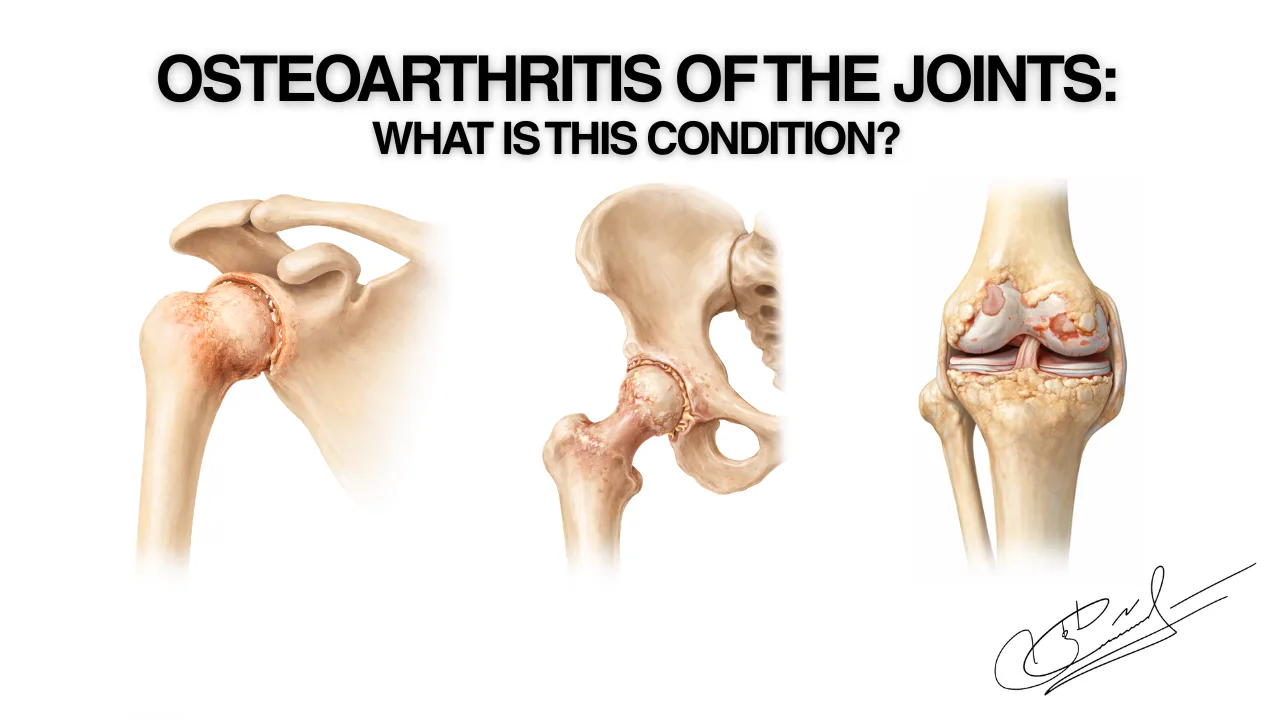
Osteoarthritis of the joints: what is this condition and why does it develop?
What happens in the joint in osteoarthritis
Osteoarthritis is a chronic joint condition in which the articular cartilage gradually breaks down and surrounding structures are affected. Cartilage plays a crucial role by allowing bones to move smoothly without friction.
Over time, this protective layer becomes thinner, the joint surface becomes irregular, and movement may be accompanied by pain and stiffness.
As the condition progresses, other joint structures may also be involved, including bone tissue, ligaments, and the joint capsule. For this reason, osteoarthritis is considered not only a cartilage disorder, but a complex disease of the entire joint.
Why osteoarthritis develops
Osteoarthritis does not occur suddenly. It usually develops under the influence of multiple factors that gradually alter joint structure.
The most common causes include:
• age-related changes in cartilage;
• increased mechanical load on the joint;
• consequences of previous injuries;
• congenital anatomical variations;
• excess body weight;
• history of inflammatory joint conditions.
In some cases, the disease progresses slowly and may not cause noticeable symptoms for a long time, which is why many patients seek medical attention at later stages.
Which joints are most commonly affected
Osteoarthritis can develop in almost any joint, but it most often affects large joints that bear significant load.
The most common forms include:
• hip osteoarthritis;
• knee osteoarthritis;
• shoulder osteoarthritis.
Each type has its own clinical features and treatment considerations.
How osteoarthritis presents
Symptoms often develop gradually. In early stages, a person may experience only mild discomfort after physical activity.
Over time, the following symptoms may appear:
• pain during movement;
• morning stiffness;
• reduced range of motion;
• a grinding or clicking sensation in the joint;
• decreased endurance during walking or physical activity.
The severity of symptoms often depends on the extent of joint degeneration.
Stages of osteoarthritis
The disease progresses gradually through several stages.
In early stages, changes may be minimal and detectable only through imaging. In later stages, cartilage damage becomes more pronounced, and joint function may be significantly impaired.
(For more details, see “Stages of osteoarthritis.”)
Why proper interpretation of imaging matters
When osteoarthritis is suspected, a doctor may order X-rays, MRI, or CT scans. However, imaging findings must always be interpreted in conjunction with the clinical picture.
In some cases, imaging may show significant changes while symptoms remain mild. In others, the opposite may occur.
(For more details, see “Errors in interpreting MRI and CT scans of joints: why imaging is not a diagnosis.”)
Is surgery always necessary?
In many cases, treatment begins with conservative methods. These may include load modification, physical therapy, medications, and other non-surgical approaches.
Surgical treatment is considered only when other methods fail to restore joint function or relieve pain.
(For more details, see “You’ve been advised to undergo surgery: how to know if it’s really necessary?”)
Why doctors’ opinions may differ
There can be different approaches to joint treatment depending on the patient’s individual characteristics, stage of the disease, and the specialist’s experience.
Patients may sometimes receive different recommendations from different doctors. In such cases, it is important to evaluate the reasoning behind each opinion and consider the overall clinical picture.
(For more details, see “Different doctors, different opinions: who should you trust when choosing joint treatment?”)
Osteoarthritis is one of the most common joint conditions, developing gradually and involving changes in cartilage and other joint structures.
Its causes may vary, including age-related changes, mechanical load, previous injuries, and individual anatomical factors.
Early consultation with a specialist helps detect the condition in time and choose the most appropriate treatment strategy.
