

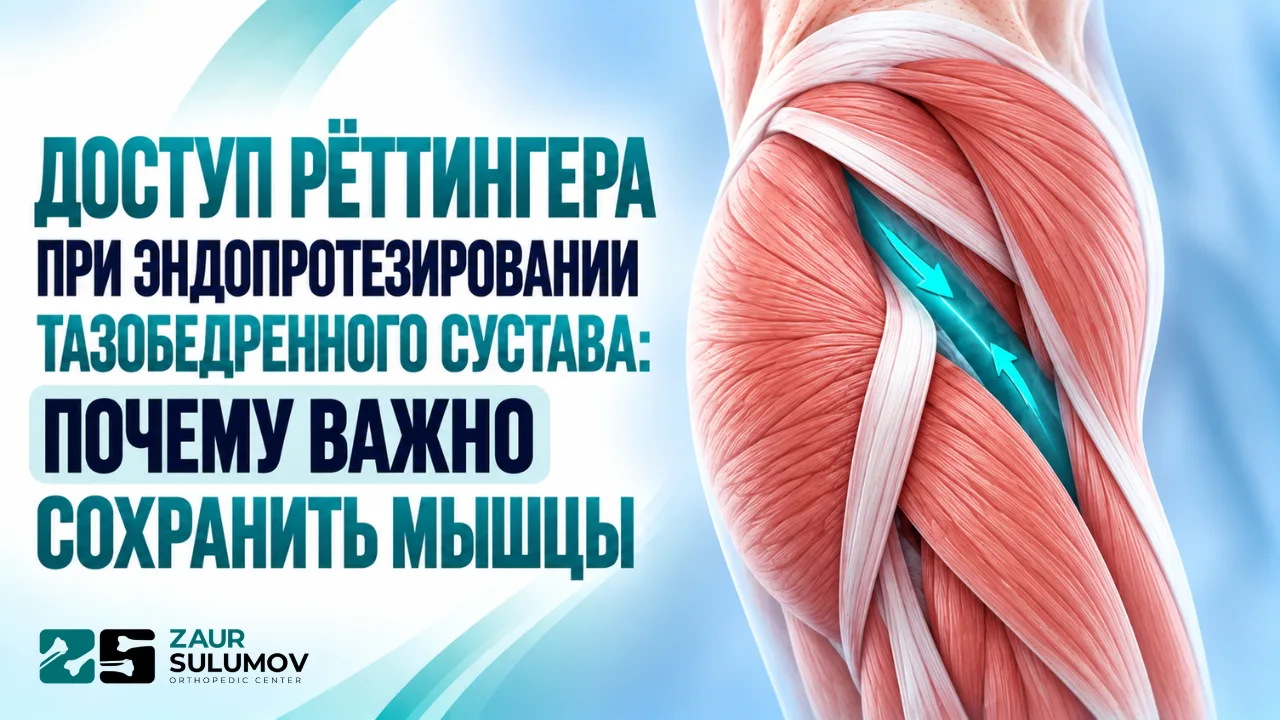
The Röttinger approach in hip replacement: why preserving muscles matters
People preparing for hip replacement are concerned about more than the operation itself. They want to know how soon they can get up, walk confidently again and return to everyday activities. Recovery is influenced in part by the surgical approach: the route the surgeon takes to reach the joint. With the Röttinger approach, the surgeon passes between muscles and preserves the main part of the gluteus medius. This is one of the method's main advantages for the patient.
Why preserving the gluteus medius matters
The gluteus medius helps keep the pelvis level when a person walks and shifts their weight onto one leg. If it is not working well enough, walking may become unsteady and a limp may develop. Hip replacement therefore requires attention not only to implant placement but also to the muscles that will support movement after surgery.
With the Röttinger approach, the surgeon uses the natural interval between the gluteus medius and a neighbouring thigh muscle. The main part of the gluteus medius does not need to be divided to reach the joint, avoiding the subsequent need for that division to heal. This creates favourable conditions for early recovery: the patient gradually regains strength, balance and confidence in walking while retaining an important muscular mechanism.
What research shows
In a study directly comparing the Röttinger and Hardinge approaches, blood loss was lower with Röttinger, although the operation took longer. After one year, joint function scores and gait-analysis findings were similar in the two groups. The benefits of a tissue-sparing approach should therefore be considered particularly in relation to the operation and early recovery, without promising differences that the researchers did not find at one year. Study by Martin and colleagues.
Muscle condition has also been assessed using MRI. In one study, changes in the gluteus medius were less pronounced after a minimally invasive anterolateral approach than after a modified direct lateral approach. These findings help explain why muscle preservation is considered an important advantage of anterolateral intermuscular techniques. Study by Müller and colleagues.
In a large 2026 analysis, researchers compared the results of 85 randomised studies of different surgical approaches. Minimally invasive anterolateral approaches ranked highly for recovery of joint function during the first three months and for control of blood loss during surgery. The Röttinger approach belongs to this group, although the analysis covered several related techniques rather than this approach alone. Together with direct comparative studies, these findings support considering Röttinger among the appealing options for tissue-sparing joint replacement. Meta-analysis by Wang and colleagues.
How Röttinger differs from other approaches
Surgical approach names can be confusing because they all lead to the same joint. Röttinger is an anterolateral intermuscular approach: the surgeon passes between muscles. Hardinge is a direct lateral approach, in which the surgeon works through part of the hip abductor muscles. DAA is the direct anterior approach, a separate technique with a different direction of access.
For the patient, the key feature of Röttinger is preservation of the main part of the gluteus medius. This muscle is needed from the first steps after surgery, when balance and gradual recovery of gait matter. The approach is therefore particularly appealing when gentle handling of soft tissues and a return to confident walking are priorities.
How the surgeon plans the operation
Before hip replacement, the surgeon reviews imaging and assesses the shape of the joint, the condition of the bones and muscles, the extent of deformity and the effects of previous operations. This helps plan access to the joint and the position of the implant components. The purpose of the surgical approach is to allow the entire operation to be performed accurately while preserving as much healthy tissue as possible.
The Röttinger approach combines these aims with an intermuscular technique. What matters is not only the length of the skin incision but also what happens underneath it: how the surgeon handles the muscles and how securely the implant is placed. Tissue-sparing technique is therefore considered part of the overall treatment plan, from preparation for surgery to recovery of walking.
The Röttinger approach allows hip replacement while preserving the gluteus medius, a major muscle supporting stable walking. The surgeon reaches the joint through a natural interval between muscles without dividing its main part. Preserving the muscle is particularly important in the first weeks after surgery, when the patient starts standing, shifting weight onto the leg and walking confidently again. Studies show favourable early results for minimally invasive anterolateral approaches and support their advantage in controlling blood loss. This combination of muscle preservation and encouraging early results makes Röttinger one of the appealing options for modern hip replacement.
