

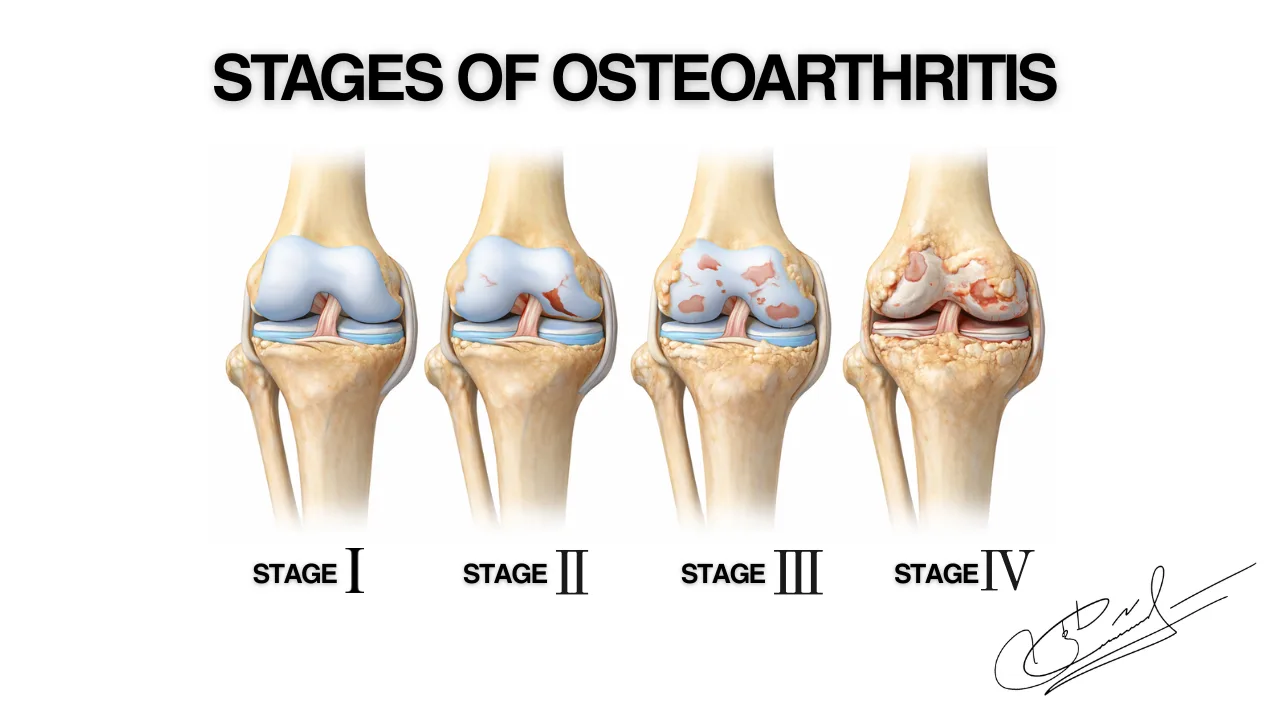
Stages of osteoarthritis: how the joint changes over time
Why osteoarthritis develops gradually
Osteoarthritis is a condition that develops over time rather than occurring suddenly. Changes in the joint progress step by step: initially affecting the cartilage, and later involving bone structures and surrounding soft tissues.
In the early stages, a person may experience little to no discomfort. However, as the condition progresses, the joint gradually loses its normal function.
(For general causes, see “Osteoarthritis of the joints.”)
Stage I
At the initial stage, joint changes are minimal. The cartilage begins to lose its elasticity, but its structure is largely preserved.
A person may experience:
• mild discomfort after physical activity;
• short-term stiffness;
• slight fatigue during movement.
At this stage, symptoms are often overlooked, as they tend to resolve after rest.
Stage II
As osteoarthritis progresses, the cartilage gradually thins, and joint surfaces begin to change.
Symptoms become more noticeable and may include:
• pain during physical activity;
• clicking or grinding sensations;
• reduced range of motion;
• decreased endurance during walking.
This is often the stage when patients first seek medical attention.
Stage III
In more advanced stages, cartilage damage becomes significant, and joint surfaces may be markedly altered.
Movement becomes more limited, and pain may occur even with minimal load. Patients may begin to change their gait or avoid certain movements.
Such changes are commonly seen in conditions like hip osteoarthritis or knee osteoarthritis at advanced stages.
Stage IV
At the most advanced stage, joint surfaces may be severely damaged. Cartilage is nearly absent, and joint movement becomes significantly restricted.
Pain may occur not only during movement but also at rest. At this stage, the condition can greatly affect quality of life and daily activity.
When surgery may be considered
Surgical treatment is not required at every stage of osteoarthritis. In many cases, early stages are managed with conservative methods aimed at reducing symptoms and preserving joint function.
However, when joint damage becomes advanced and function is significantly impaired, surgery may be considered.
(For more details, see “You’ve been advised to undergo surgery: how to know if it’s really necessary?”)
Why revision may sometimes be needed
In some cases, patients have already undergone joint surgery but later develop new symptoms or functional issues.
In such situations, it is important to reassess the condition and the treatment strategy.
(For more details, see “Revision joint surgery: when should the strategy be reconsidered?”)
Osteoarthritis develops gradually and progresses through several stages, each associated with specific structural changes and symptoms.
In early stages, it may present only with mild discomfort, but as the disease progresses, pain and movement limitations can increase.
Understanding the stages of osteoarthritis helps patients seek medical advice in time and choose the most appropriate treatment strategy.
