

Which Patients Is the CORI Robot Suitable For?
When a person learns about robotic knee replacement, one of the first questions is simple: is this technology suitable for me?
It may seem that the answer should be straightforward. If robotic surgery is a modern area of orthopedics, perhaps every patient should use it. Real clinical practice is more nuanced.
The CORI robotic system does not exist separately from the patient and the disease. Its possibilities become useful in specific situations that the surgeon faces during knee replacement. It is more correct to consider the clinical tasks of the operation rather than only age or lifestyle.
Is CORI suitable for severe knee osteoarthritis?
Most patients become interested in robotic knee replacement at the stage of advanced osteoarthritis, when conservative treatment no longer provides enough relief.
In such cases patients often have constant pain, restricted movement, walking difficulty and reduced usual activity. These patients are commonly considered candidates for knee replacement. If the surgeon decides that surgery is needed, a robotic system can be used as an additional tool for planning and navigation.
However, severe osteoarthritis alone does not automatically mean that robotic technology must be used. The decision is made individually after examination and consultation.
Can CORI be used with pronounced deformities?
Changes in leg alignment are a common reason to consult an orthopedic surgeon. Some patients develop a bow-legged deformity, while others develop a knock-kneed position. Sometimes the change is visible even before X-rays.
Such cases require especially careful surgical planning. The surgeon must take into account the initial limb position and joint features before implant placement.
For this reason, patients with pronounced deformities often ask about robotic technologies and digital navigation. Still, deformity is not an automatic indication for a robot. It is one clinical situation in which modern technology may support the surgeon.
Is the technology suitable for active patients?
In recent years, the average profile of knee replacement patients has been changing. More people who continue working, travel, move a lot and do not want to accept serious mobility limits come for consultation.
Such patients usually want to understand treatment options in detail before surgery. They are interested not only in the fact of joint replacement, but also in the technologies used during the procedure.
Robotic joint replacement attracts this group because it offers detailed planning and digital tools during surgery. Activity level alone does not determine whether a robot is necessary, but active patients often study these technologies most carefully.
Can CORI be used after previous knee surgery?
Some patients have already had operations on the knee: sports injury procedures, ligament reconstruction, fracture treatment, deformity correction or other orthopedic interventions.
After such procedures, knee anatomy can differ from standard anatomy. There may be consequences of trauma, changes in bone structure or traces of previous surgery.
Before joint replacement, these patients require careful assessment. This is one reason why people with a surgical history often ask about robotic technologies and modern navigation. Each case must be analyzed individually.
Is CORI suitable for older patients?
There is a misconception that robotic surgery is intended only for younger or working-age patients. Age itself is not the determining factor in choosing a joint replacement technology.
General health, the nature of the disease, bone quality and accompanying conditions are more important. CORI can be used in different age groups if the surgeon considers it appropriate for the clinical situation.
Age alone does not make a person a better or worse candidate for robotic surgery.
Are there patients who absolutely need a robot?
This question arises at many consultations. Patients often expect a list of indications where robotic surgery is mandatory.
Modern orthopedics does not work this way. There are no universal international recommendations requiring knee replacement to be performed only with a robot for a specific category of patients.
CORI is a tool that helps the surgeon obtain additional information and use digital navigation. The decision to use it depends on multiple factors and is always individual.
How can you know whether CORI is right for you?
There is no universal answer. Even patients with the same diagnosis can have very different joint features, X-ray findings and previous treatment histories.
The usefulness of a robotic system can be determined only after a full examination and consultation with a surgeon. The doctor assesses the joint, imaging results and possible treatment options, then discusses the features of the upcoming operation.
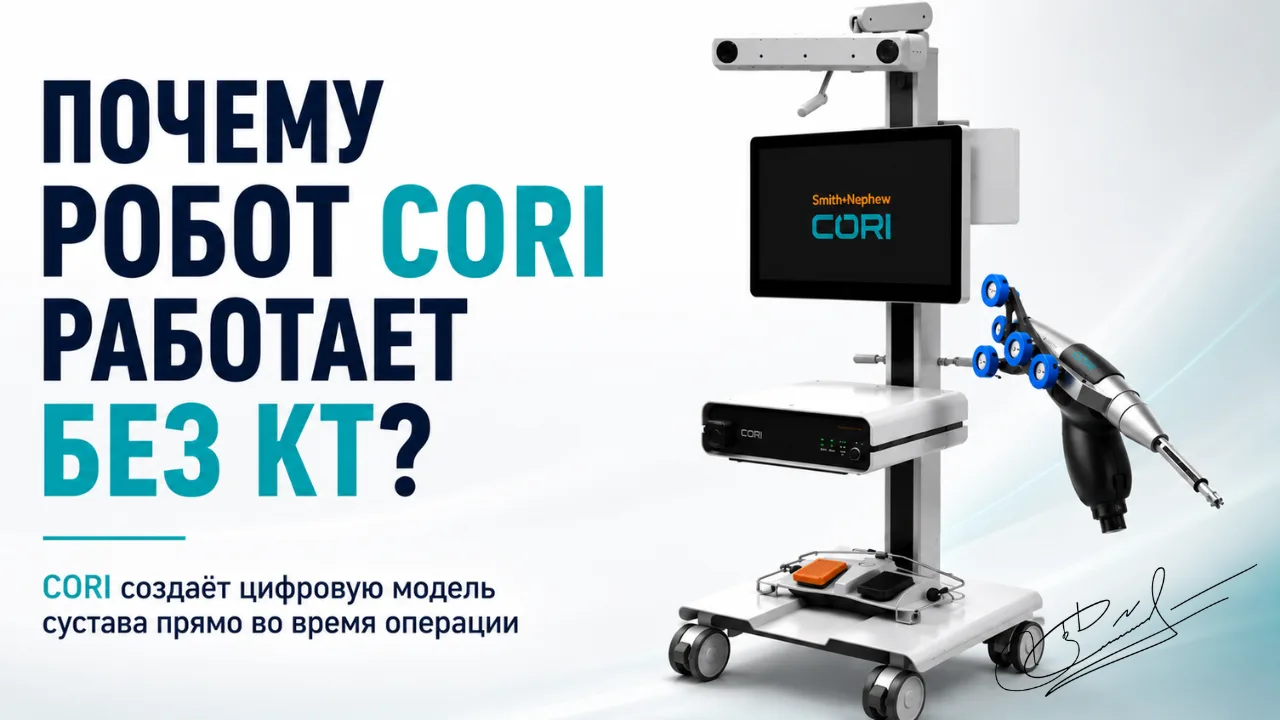
If you want to understand how the technology works, read "Why the CORI Robot Works Without Preoperative CT".
The CORI robotic system can be used in different groups of patients planned for knee replacement. It is often of interest in severe osteoarthritis, limb deformity, high daily activity or previous knee surgery.
There is no universal list of patients for whom robotic surgery is always suitable or never suitable. The decision is made individually and depends on the clinical situation. A surgeon's consultation remains the key step.