
Why CUVIS Helps Position the Implant More Accurately
When patients study modern knee replacement technologies, they often encounter the term "implant positioning accuracy." Equipment manufacturers, surgeons and medical articles mention it regularly, but do not always explain why it matters.
At first glance, knee replacement may seem simple: remove damaged surfaces and place an artificial joint. In reality, modern joint replacement is more complex. The surgeon must consider not only the presence of the implant, but also the position of its components in relation to the bones, limb axis and individual anatomy.
This is why implant positioning has become one of the central topics in robotic surgery.
What is implant positioning?
Implant positioning means the location of the implant components inside the knee after placement.
For a patient, the implant may look like one structure. For the surgeon, it consists of several components that must be placed with the patient's anatomy in mind.
During surgery, the specialist determines component size, position, orientation and relationship to each other. Each of these parameters is part of the overall positioning picture.
Why does correct implant position matter?
The knee experiences substantial load every day. Even ordinary walking repeatedly transfers body weight through the joint.
After joint replacement, these loads continue to act through an artificial joint. For this reason, surgeons pay close attention to implant component position. Surgical planning takes into account joint anatomy, limb alignment, disease pattern and many other factors.
The more precisely the surgeon understands the initial situation, the more opportunities there are to adapt the operation to the patient.
Why is the same approach not suitable for everyone?
Joints can differ greatly between patients. Even if two people receive the same implant model, their anatomy remains different: bone size, joint surface shape, mechanical axis and the consequences of previous disease or trauma can vary.
Osteoarthritis also rarely develops in exactly the same way. In one patient it may affect mainly one compartment; in another it may involve several zones.
Modern joint replacement is therefore moving away from the average-patient concept and toward adaptation to individual anatomy. This idea is one of the foundations of new-generation robotic technologies.
What role does CUVIS play in implant positioning?
The main task of a robotic system is to give the surgeon additional control tools during the operation.
In traditional joint replacement, the specialist relies on examinations, instruments, anatomical landmarks and experience. This approach remains effective and widely used.
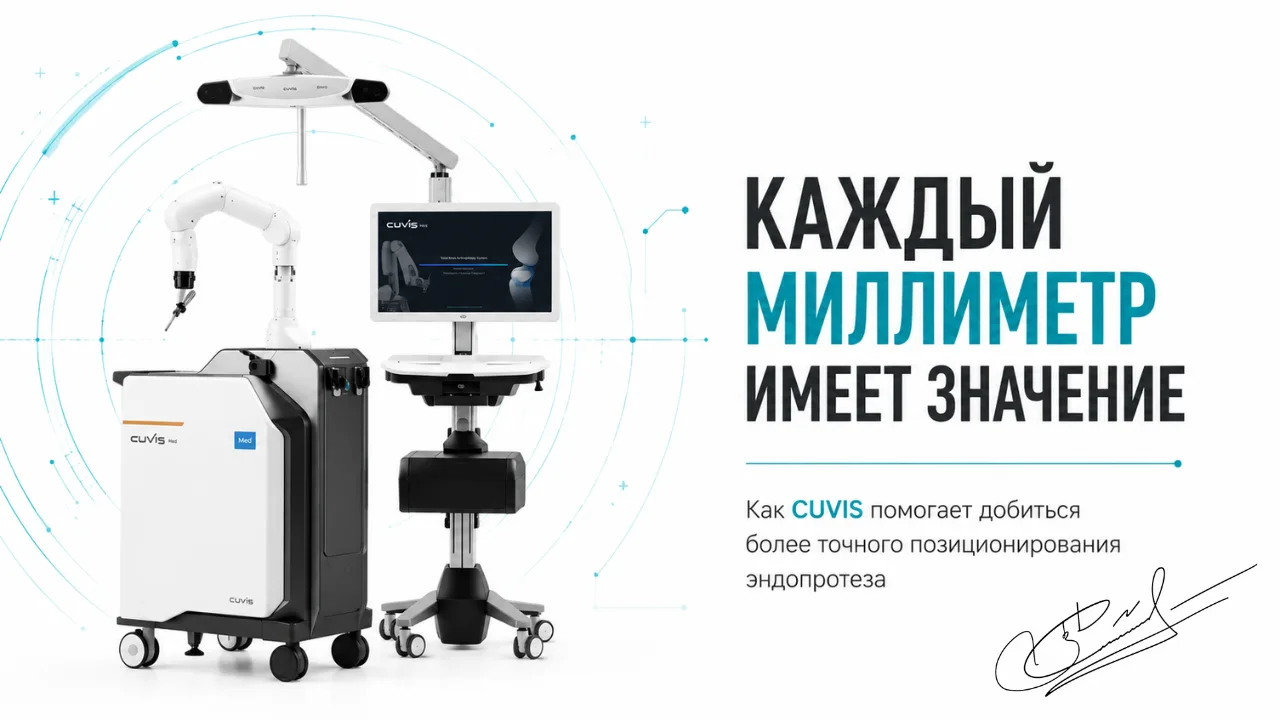
CUVIS does not cancel existing surgical principles. It supplements them with digital technology and helps the surgeon analyze parameters related to implant component position during planning and performance of the operation.
The technology is therefore an additional control instrument, not a replacement for surgical skill.
Why can accuracy not be reduced to one number?
Promotional materials sometimes create the impression that surgical accuracy can be expressed by a single figure. Clinical practice is more complex.
Implant positioning includes many linked parameters: component position, orientation, interaction with anatomical structures and overall joint biomechanics.
Specialists therefore view accuracy not as a single indicator, but as a complex process involving several stages of analysis and control.
Why is digital control becoming more important?
In recent years, the amount of information available to the surgeon during joint replacement has increased. Orthopedics increasingly uses digital tools that help analyze surgical parameters and take more factors into account.
The reason is simple: the more objective data the specialist receives, the more complete the understanding of the clinical situation becomes.
CUVIS is developing in this direction: not only as equipment, but as a way to improve analysis and control during surgery.
How is this article different from the article about real-time data?
The topics may seem similar, but there is an important distinction. Here the focus is the final task: implant component position and why surgeons pay so much attention to it.
The article "What Data CUVIS Shows the Surgeon in Real Time" discusses specific measurements and parameters used during surgery. Implant positioning is the goal; data and measurements are tools that help achieve it.
Implant positioning is a key aspect of modern knee replacement. The location, orientation and relationship of implant components must correspond to the patient's individual anatomy.
The CUVIS robotic system helps the surgeon use additional control and analysis tools during surgery. It does not replace the doctor's experience, but provides more objective information for decision-making.